The sports pulps get a category of their own — scoped, like everything in this volume, to 1900–1930. In those years sport mostly lived inside the general-fiction pulps, in football and baseball numbers like The Popular Magazine’s for November 1913, until Street & Smith launched Sport Story Magazine in September 1923, the first all-sports pulp, and Fiction House followed in 1928 with Fight Stories, the first sports pulp devoted to a single sport. The flood that followed — Dime Sports in 1935, Thrilling Sports in 1936, and dozens more — belongs to Volume Two. The historian of the whole field is Michelle Nolan, whose McFarland books are noted below; McFarland is also the publisher of Laurie Powers’ Queen of the Pulps.
Example cover
No cover of Sport Story Magazine is reproduced in this volume yet — a public-domain scan from 1930 or earlier is still to be sourced for this box. Identifications welcome.
Sport Story Magazine
Street & Smith · From September 8, 1923 · Sports · The first all-sports pulp
Street & Smith knew sport sold: Gilbert Patten’s Frank Merriwell had carried the firm’s story papers for a generation. With its first issue, dated September 8, 1923 and priced at fifteen cents, Sport Story Magazine became the first pulp devoted entirely to sport — baseball, boxing and horse racing alongside polo, auto racing and tennis. Except for the occasional sports yarn in the general-fiction pulps such as Argosy and Blue Book, it had the market to itself for most of the next five years, until Fight Stories arrived in 1928. It ran on into the 1940s; this volume covers its 1923–1930 years.
Its artists in this indexIts 1920s cover artists are not yet pinned down in this index — identifications welcome.
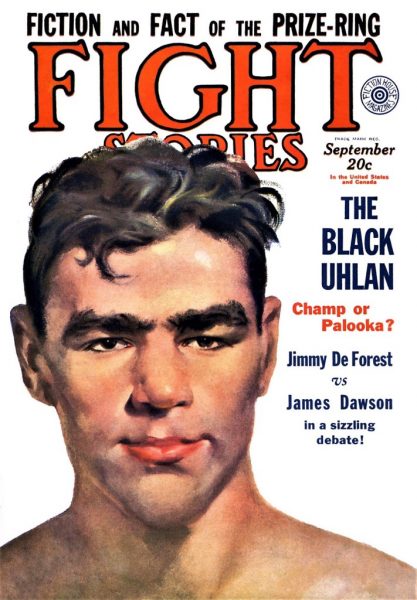
September 1930 · Earle K. Bergey“The Black Uhlan: Champ or Palooka?” — Bergey’s prize-ring portraiture in the volume’s final year. Tap the picture to see it larger.
Fight Stories
Fiction House · From June 1928 · Boxing · The first single-sport pulp
Fiction House launched Fight Stories in mid-1928 — the first specialized sports pulp, devoted to the prize ring: “FICTION and FACT of the RING,” as its masthead promised, under its first editor, William H. Kofoed. Its September 1930 cover, by Earle K. Bergey, pictured Jack Dempsey himself. From 1929 it also carried Robert E. Howard’s Sailor Steve Costigan boxing yarns — Howard crossing over from Weird Tales to the ring. The magazine ran 106 issues in all, to 1952, with a hiatus in the 1930s; this volume covers its first run, 1928–1930.
Its artists in this indexEarle K. Bergey — among its earliest cover painters; the September 1930 cover reproduced here · The first-issue cover (June 1928) was by Abell Sturges, who is not in this index
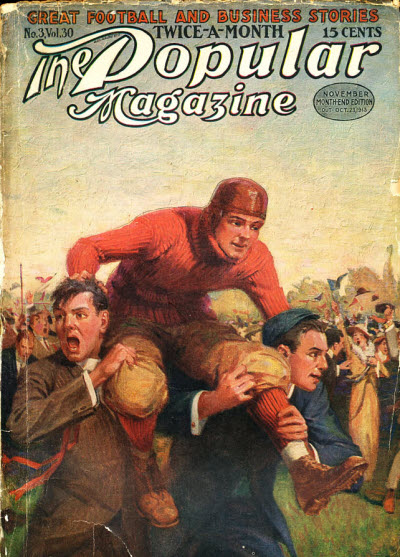
November 1913The football number — general pulps sold sport as hard as adventure. Tap the picture to see it larger.
Sport in the General Pulps
The Popular Magazine · November 1913 · The football number
Before sport had pulps of its own, it had numbers of everybody else’s. The general-fiction giants — The Popular Magazine, Argosy, Blue Book, filed on the Adventure page — sold sport as hard as adventure, none more openly than The Popular Magazine’s football number for November 1913, its hero carried off the field on his teammates’ shoulders. The sports pulps of the 1920s grew straight out of covers like this one.
Filed withThe Popular Magazine’s full entry, and its artists, are on the Adventure page
The books — Michelle Nolan on the sports pulps
The sports pulps have their historian, as Love Story has Laurie Powers: Michelle Nolan, a newspaper and magazine feature writer of more than fifty years’ standing, who writes on the sports pulps for the same publisher as Powers — McFarland. Both of her sports books range well past this volume’s 1930 close; the category above stays inside Volume One, and her books are where to follow the field into the decades after.
Baseball and Football Pulp Fiction
McFarland · 2020
The pulp-specific history
Six Publishers, with a Directory of Stories, 1935–1957. The first book devoted to baseball and football pulp fiction: the authors, the plots and themes, and a complete catalog of the fiction from the six major publishers who competed with Street & Smith — with cover themes and an index to the cover artists, where known, for 1,054 issues. This is the cleaner link for the sports pulps themselves.
A Study of Baseball, Basketball and Football Fiction of the 1930s through 1960s. The wider history Nolan wrote first: sports fiction from the dime-novel Merriwells through the pulps to the postwar boys’ books, with chapters on the rise and decline of the sports pulps — and an appendix listing the sports pulp magazines themselves.
McFarland · 2010 · 287 pages · ISBN 978-0-7864-3985-0