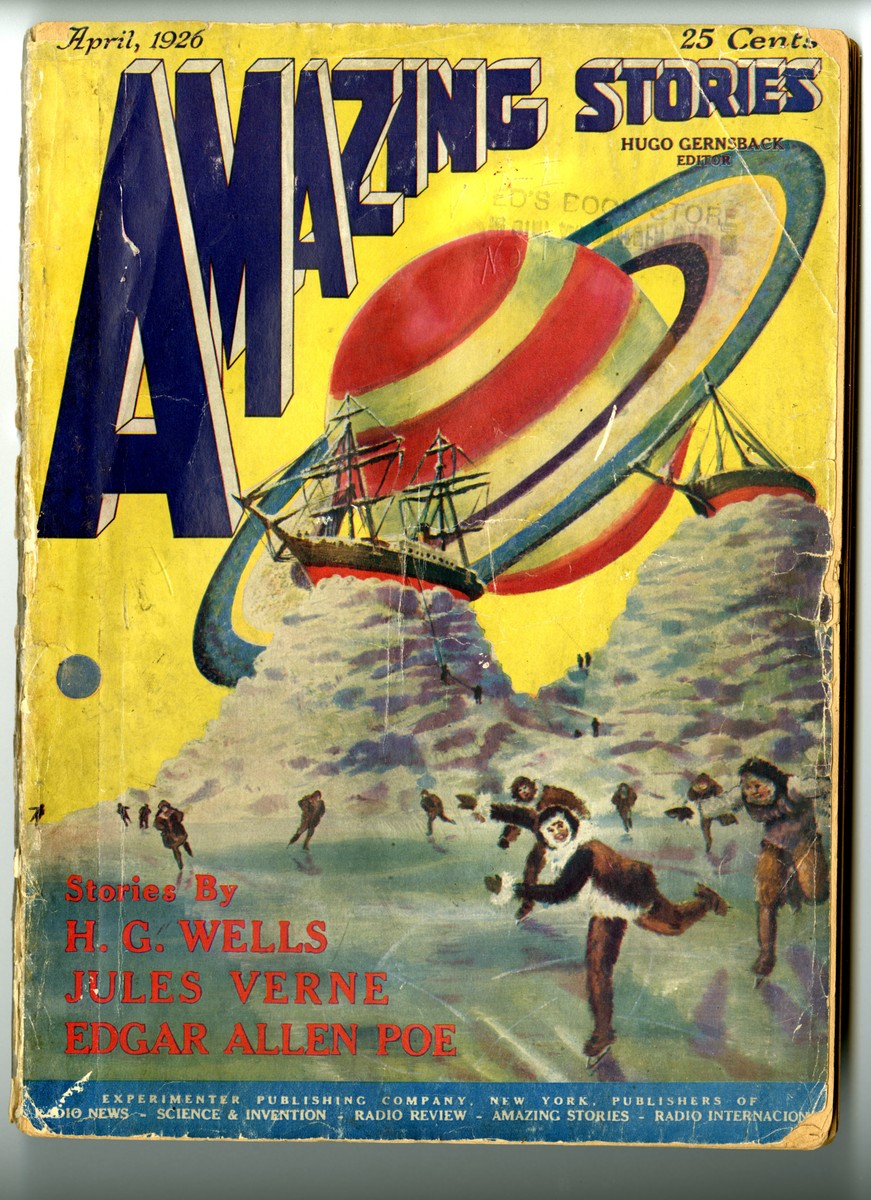
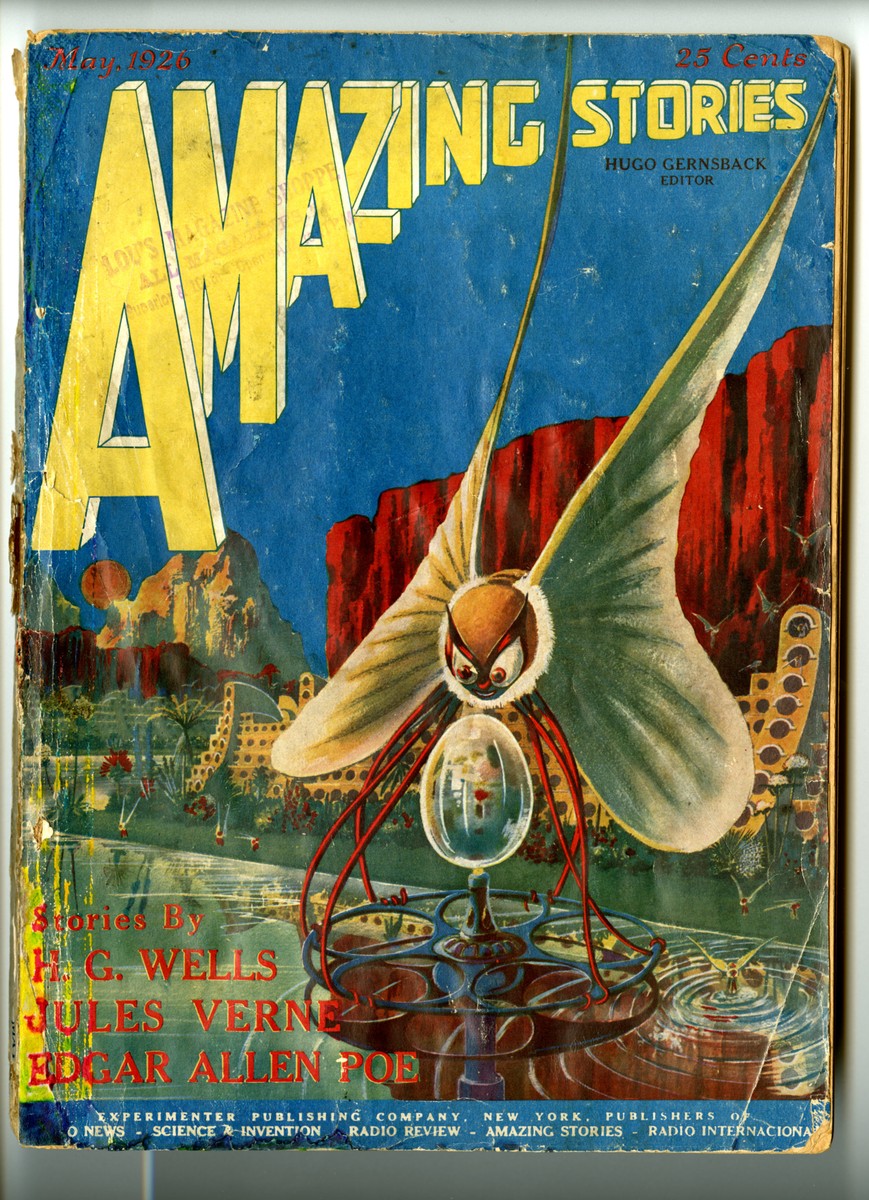
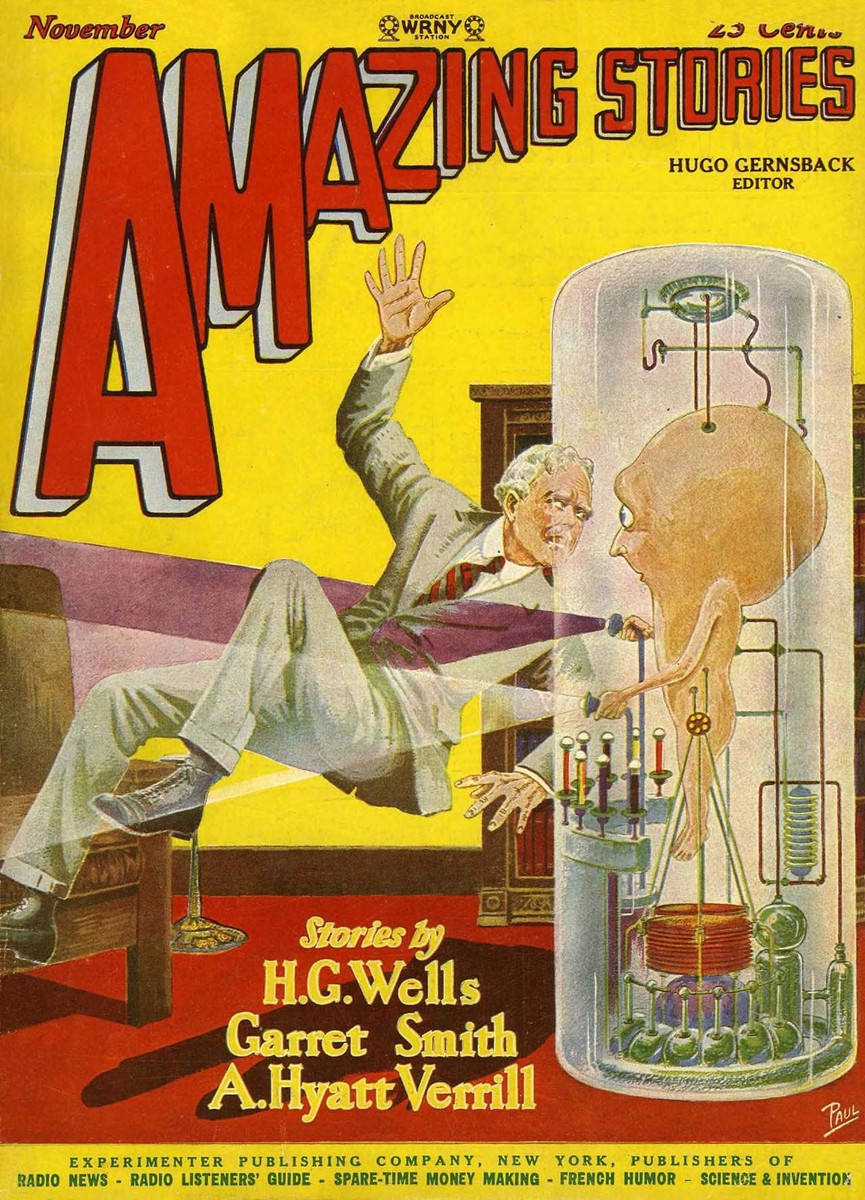
Frank R. Paul’s first Amazing cover leads this page, and rightly: when Hugo Gernsback launched Amazing Stories in April 1926 — the first magazine devoted entirely to science fiction — Paul painted its covers and gave the future a face. He is profiled in the Artist Index and his covers anchor the gallery. This page is about everybody else: the artists who were picturing spaceflight, Martian kingdoms, and tomorrow's machines before there was a science-fiction pulp to paint for, and the new hands who stepped in the moment Paul moved on. One interior artist from Paul's own cover years, J. M. de Aragon, is filed with them below — his work was inside the magazine, not on its covers. Everything dated here was published in 1930 or earlier — this volume's public-domain rule — and every attribution follows a documented source, named in the footer. Where the record is thin, the entry says so.
Main illustrationAmazing Stories, April 1926 — the first issue of the first science-fiction pulp, with a cover by Frank R. Paul. Tap the cover to see it larger.
Amazing Stories · May 1926Paul’s second issue: a giant winged Martian over an alien landscape. Tap the picture to see it larger.Amazing Stories · Nov. 1927Paul’s second year: a laboratory marvel in a glass tank. Tap the picture to see it larger.
Before 1926: the future lived in other magazines
For the teens and early twenties there was no science-fiction section on the newsstand. The stories ran as planetary romance and lost-world adventure in the general pulps — All-Story and Argosy above all — and as imagined inventions in Gernsback's technical magazines, Electrical Experimenter (from 1913) and its successor Science and Invention (from 1920). The August 1923 Science and Invention was a special “Scientific Fiction Number” — the bridge to Amazing three years later. Two kinds of artist did the picturing: the Burroughs illustrators, who drew Mars as romantic adventure, and the technical illustrators, who drew it as engineering.
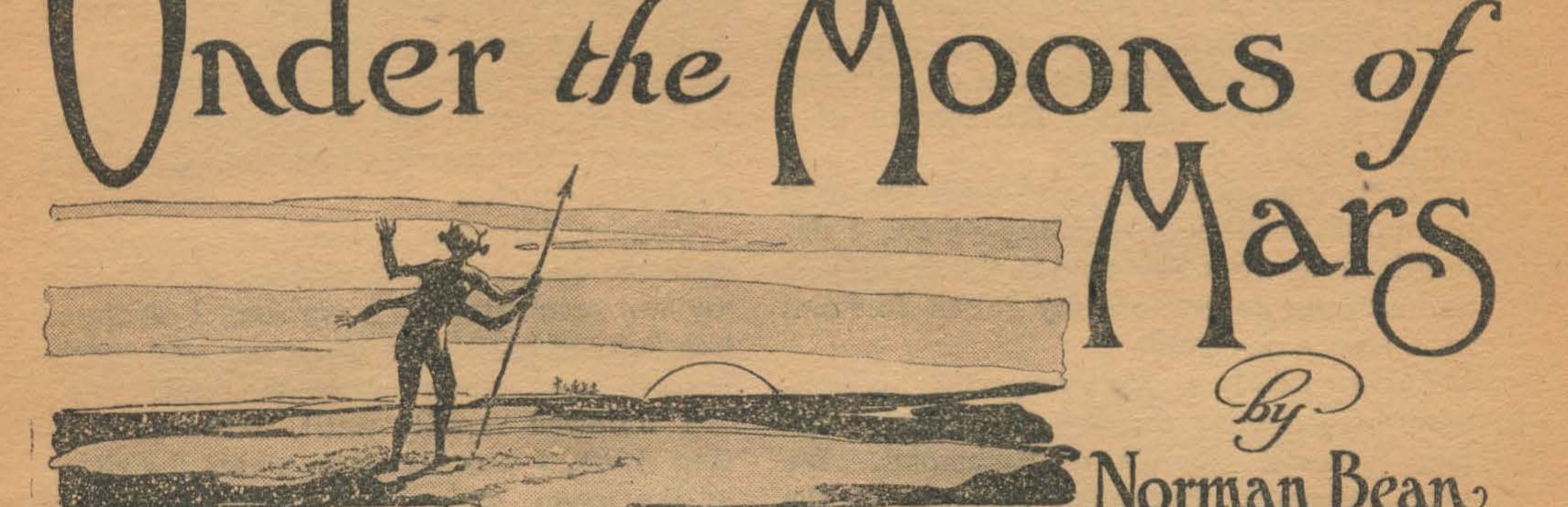
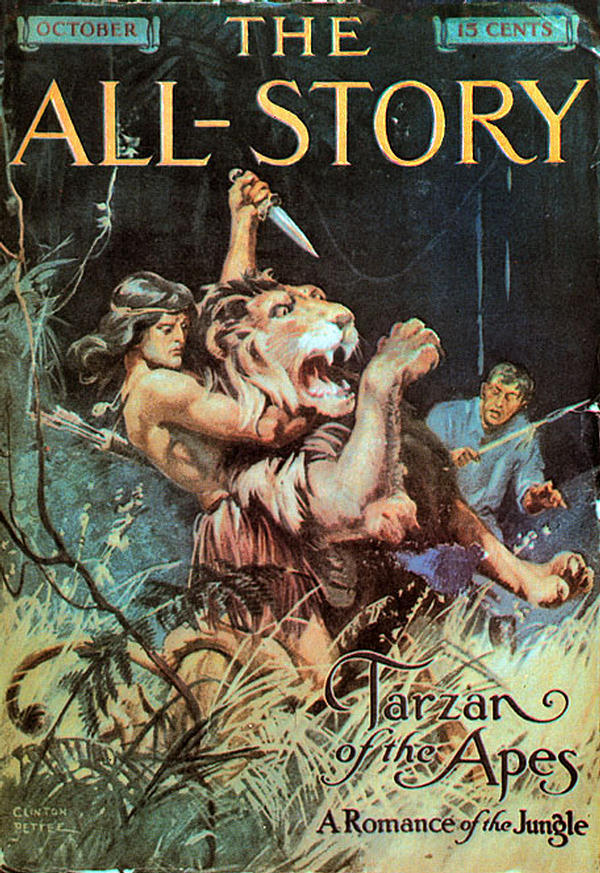
Inside The All-Story · Feb. 1912The heading for “Under the Moons of Mars” — Mars pictured inside a general pulp, fourteen years before Amazing. Tap the picture to see it larger.The All-Story · October 1912Tarzan of the Apes complete in one issue — the Burroughs boom begins on this cover. Tap the picture to see it larger.
Howard V. Brown
1878–1945 · Technical & science-fiction covers · The Gernsback years before Amazing
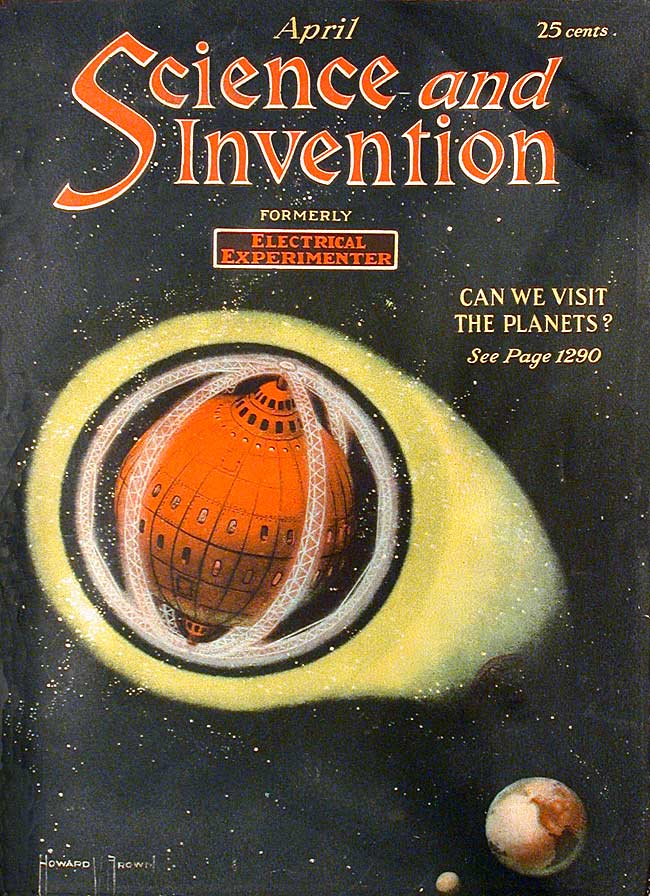
Science magazine cover · April 1921 · Howard V. BrownScience and Invention — “Can We Visit the Planets?” A science magazine cover, not a pulp cover — Brown picturing a spherical spaceship five years before Amazing. Tap the picture to see it larger.
Chicago Art Institute–trained, New York–based, and cover artist for Scientific American from about 1913 to 1931 — human figures dwarfed by gigantic technological projects were his signature years before the SF pulps existed. The Science Fiction Encyclopedia records his first artwork picturing futuristic inventions in Gernsback's Electrical Experimenter in 1916, and from 1919 onward almost 50 covers for Science and Invention. His best-documented single cover of this volume is the August 1923 “Scientific Fiction Number” of Science and Invention — a space-suited figure for G. Peyton Wertenbaker's “The Man From the Atom,” with Paul supplying interiors. In the late 1920s he also painted science-fiction covers for Argosy All-Story Weekly.
Honest limitsBrown is remembered as one of the “Big Four” SF illustrators of the 1930s (with Paul, Leo Morey, and Wesso) — but that fame is Astounding work from October 1933 on, outside this volume. In Volume One he belongs to the technical magazines and Argosy, and that is how he is filed here.
J. Allen St. John
1872–1957 · Burroughs's Mars · Planetary romance in the general pulps
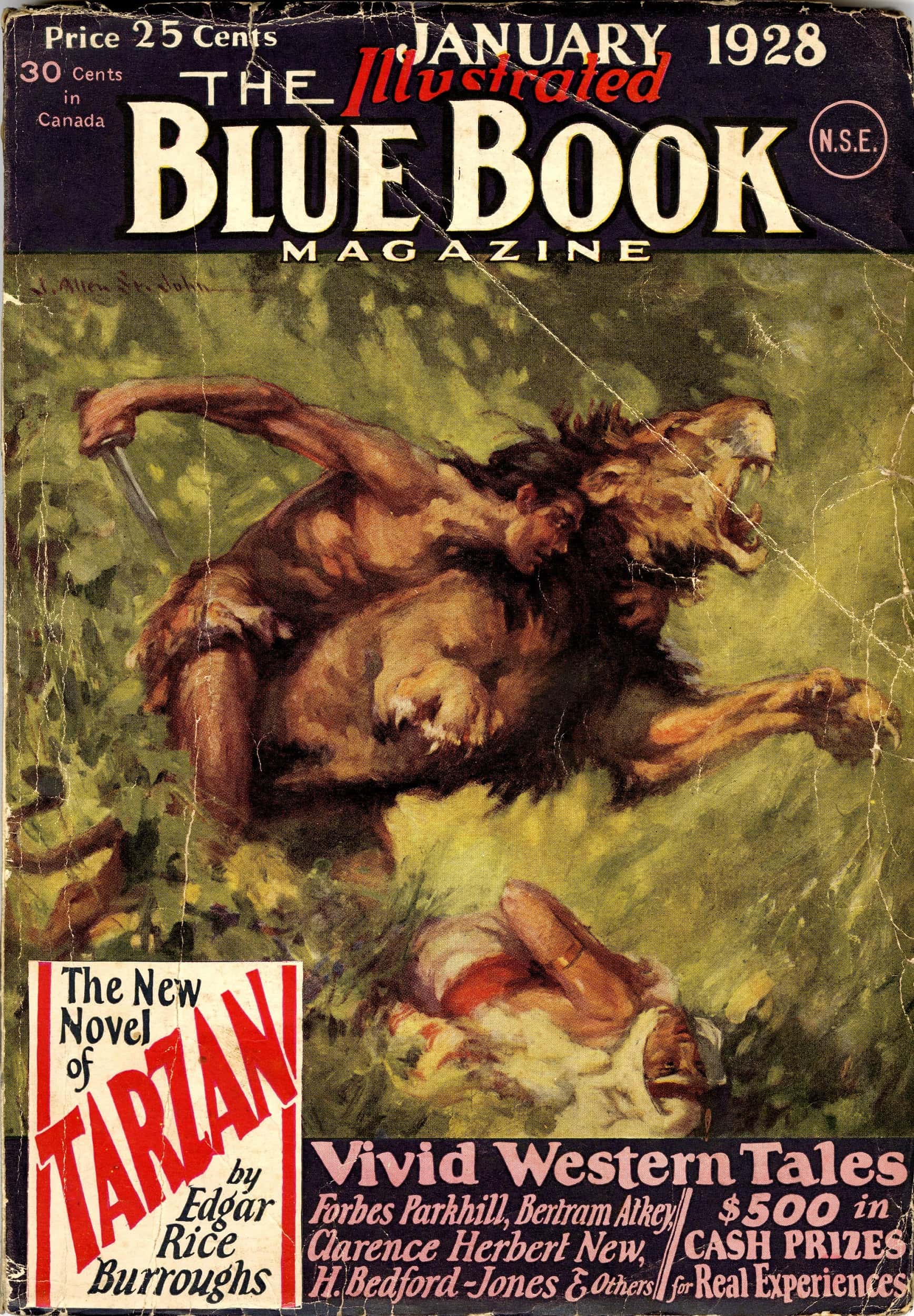
Cover by J. Allen St. JohnThe Blue Book Magazine — January 1928: Tarzan grappling with a lion, for Burroughs’s new Tarzan novel. Tap the picture to see it larger.
St. John is in the main Artist Index as Edgar Rice Burroughs's defining illustrator, and his science fiction is the Mars kind: John Carter's Barsoom began as “Under the Moons of Mars” in The All-Story (February–July 1912), and St. John's Burroughs work began in 1915, with interior illustrations for The Return of Tarzan — the first time he collaborated with Burroughs. Through the teens and twenties his covers and interiors fixed what Burroughs's Mars, Pellucidar, and Tarzan looked like, in the All-Story/Argosy serials and the books — including the January 1928 Blue Book Tarzan cover reproduced in the gallery.
Why he is on this pageBefore 1926, this was science-fiction art for most readers: not a genre magazine, but a Martian kingdom drawn inside a general-fiction pulp by a fine-art–trained painter.
Frank E. Schoonover
1877–1972 · A Princess of Mars, 1917 · The first Mars, in a book
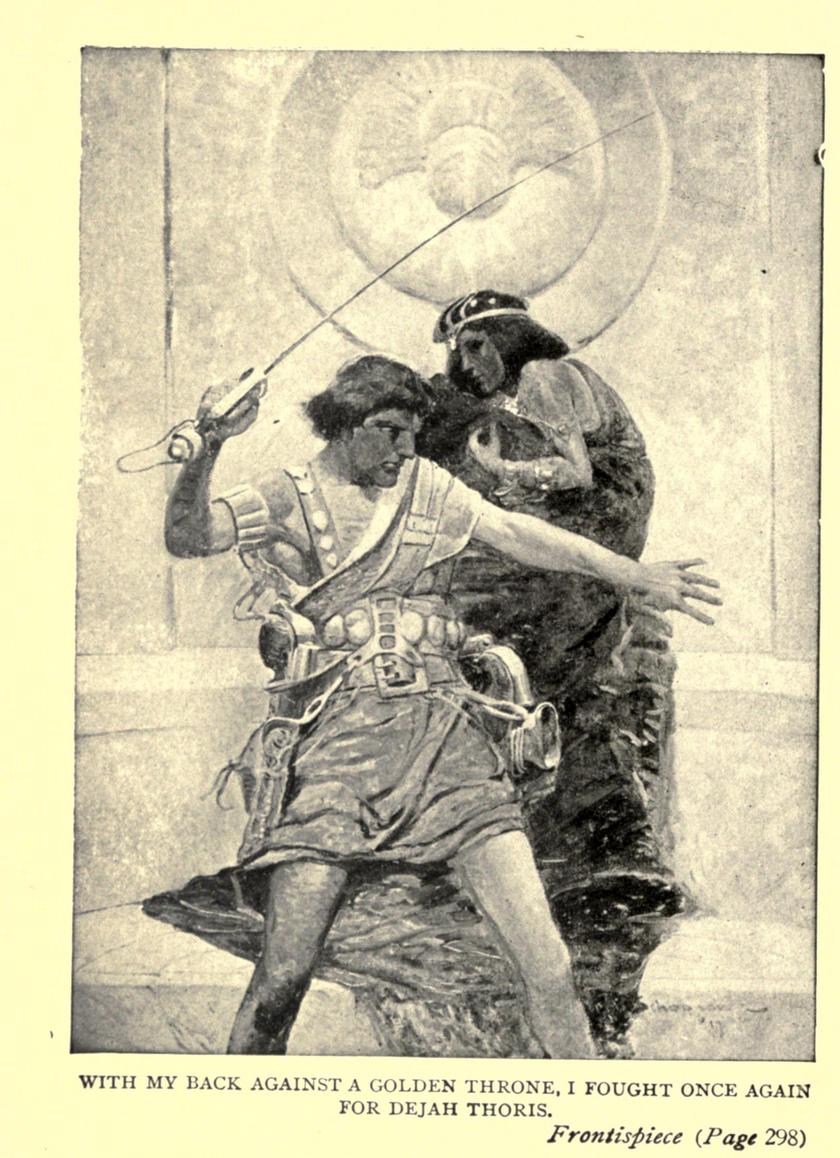
1917 book illustration · Frontispiece, A Princess of MarsSchoonover’s frontispiece — a book illustration, not a pulp cover: Carter shielding Dejah Thoris before a golden throne. Tap the picture to see it larger.
Schoonover, too, is in the main index — a Howard Pyle pupil known for frontier and historical illustration. His science-fiction credit is one famous job: he illustrated the first book edition of Burroughs's A Princess of Mars (A. C. McClurg, October 10, 1917) — frontispiece, four plates, and the dust jacket — for the novel first serialized in The All-Story in 1912. The published accounts stress how carefully he worked: he read Burroughs's descriptive passages closely and built the costumes and weapons of Barsoom from them, down to the Green Martian craftsmanship of John Carter's pistol and belt on the jacket.
Filed honestlyThis is book illustration, not a pulp cover — it is included because the 1917 Princess was the teens' most influential picture of Mars, and because Schoonover's pulp work already earns him his index place.
The record, where it is thin
Uncredited covers & a possible pseudonym · Stated, not guessed
Early science fiction was not credited the way Paul's Amazing covers were. Many Science and Invention and general-pulp SF covers are unsigned or unrecorded, and this page does not assign them. One documented uncertainty is worth naming: the July 1929 Amazing Stories cover (“A Recluse and His Guest”) is attributed in festival and reference notes to a “Hugh Mackay,” possibly a pseudonym for Leo Morey — the attribution is reported here as reported there, no stronger. If a cover artist for a 1910s–1920s SF appearance is not named on this page, it is because the sources in the footer do not name one.
The house ruleAttributions are stated only where documented; where documentation is thin, the entry says so rather than guess — the same rule as the rest of the index.
1929–1930: Paul moves on, and the field widens
In April 1929 Gernsback lost Amazing Stories in bankruptcy. Paul followed him to his new Wonder magazines — Science Wonder Stories and Air Wonder Stories, both from 1929, where Paul again did covers and interiors (see his index entry). Amazing, under T. O'Conor Sloane, needed new hands for the first time in its history, and Clayton Magazines launched a rival, Astounding Stories of Super-Science, with a January 1930 first issue. The two artists who stepped into that opening close this volume — both of them at the very start of long SF careers.
J. M. de Aragon
fl. 1927 · Amazing Stories interiors only · No covers
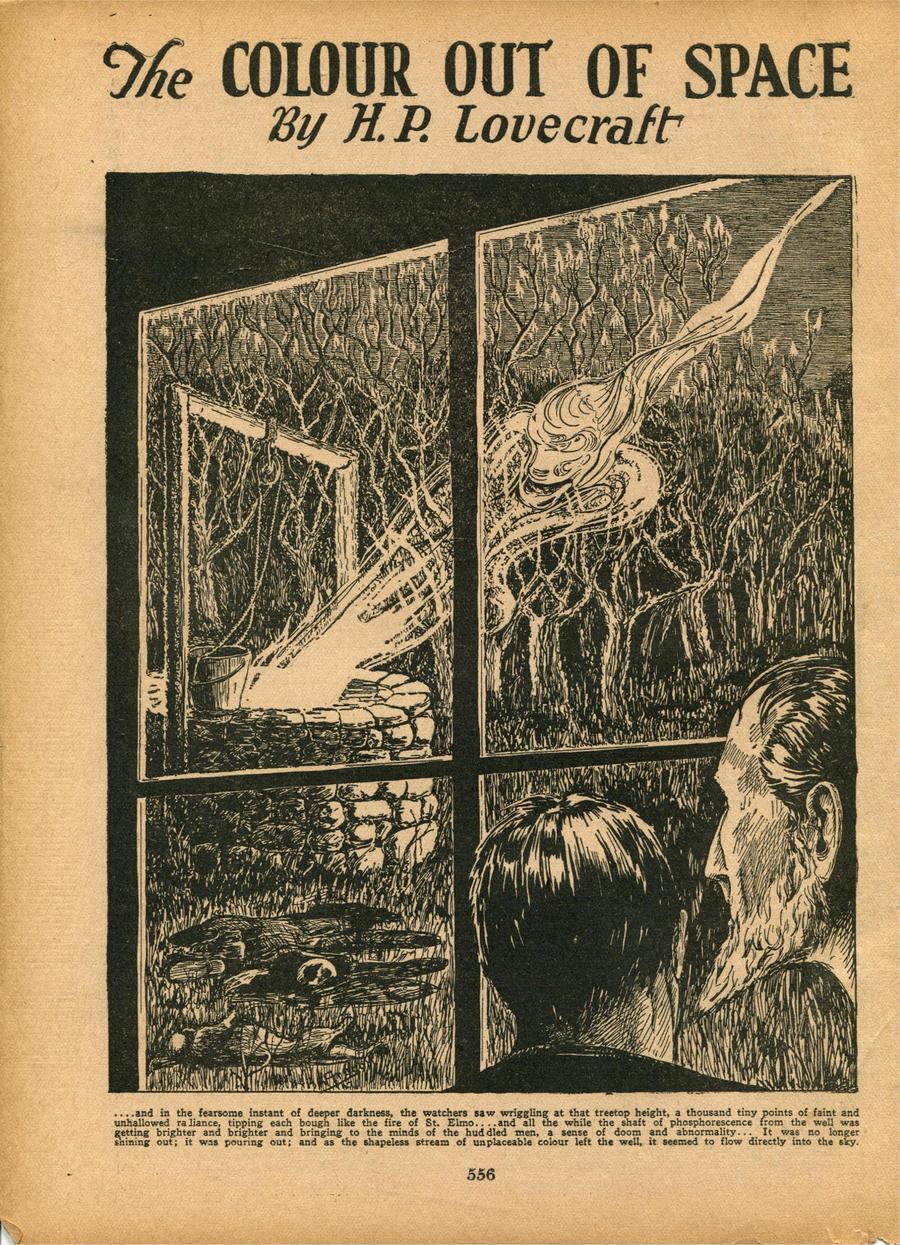
Interior · Amazing Stories, Sept. 1927, p. 556 · J. M. de AragonDe Aragon’s title-page picture for “The Colour Out of Space” — an interior illustration, not the issue’s Paul cover. Tap the picture to see it larger.
De Aragon belongs to Paul's years, not to the succession: in September 1927, while Paul painted every Amazing cover, de Aragon worked inside the magazine, illustrating H. P. Lovecraft's “The Colour Out of Space” for its first appearance. He is the interior side of the early Amazing — filed here, and in the index, as interiors only.
Filed honestlyNo cover work is documented or claimed for de Aragon in this volume; his single dated credit is the September 1927 interior job above.
Hans Wessolowski — “Wesso”
1894–1948 · Amazing Stories 1929 · The first Astounding cover, January 1930
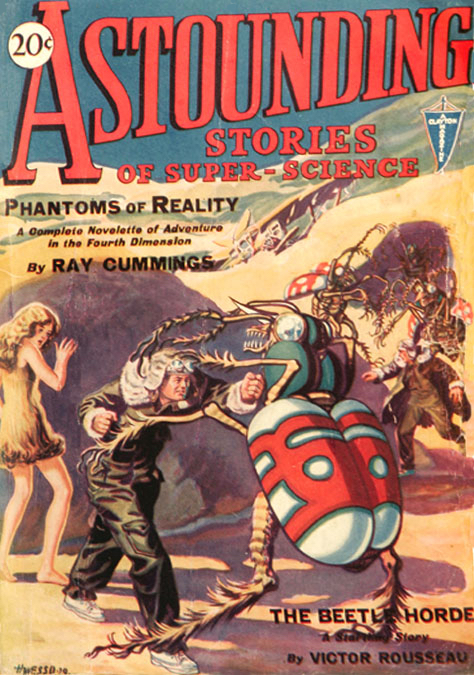
Cover by WessoAstounding Stories — January 1930, the first issue: a hero wrestling the giant beetle of “The Beetle Horde,” signed “Wesso.” The same cover is shown again with the succession below. Tap the picture to see it larger.
German-born, Berlin Royal Academy–trained, in America from 1912, Wesso began pulp covers for Clayton Magazines in July 1928 (Clues) — detective, air, and adventure titles, not science fiction. He had, by his own account as the histories report it, never heard of science fiction when Sloane hired him in September 1929 to paint Amazing Stories covers: the FictionMags-based listings credit him with the September, October, November, and December 1929 Amazing covers and the Fall 1929 Amazing Stories Quarterly cover. Late in 1929 Harry Bates hired him for Clayton's new Astounding Stories, and his January 1930 first-issue cover — a hero fighting the giant beetle of Victor Rousseau's “The Beetle Horde,” signed “Wesso” at lower left — is reproduced below.
After this volumeWesso went on to paint all 34 covers of the Clayton Astounding (January 1930–March 1933). Only the first year of that run falls inside Volume One; the rest belongs to Volume Two.
Leo Morey
1899–1965 · Amazing Stories interiors 1929 · First Amazing cover, February 1930
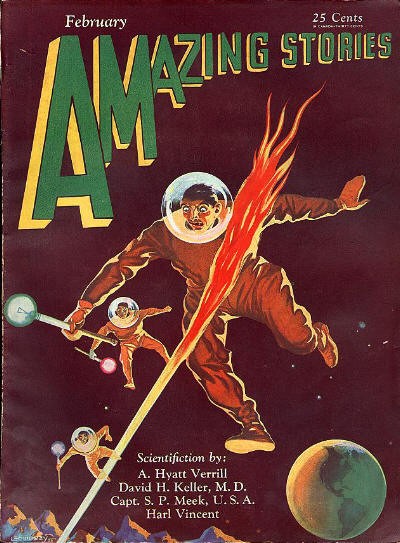
Cover by Leo MoreyAmazing Stories — February 1930: bubble-helmeted spacemen riding a beam of light — Morey’s first cover for the magazine, also shown below. Tap the picture to see it larger.
Leopoldo Morey y Peña, born in Yurimaguas, Peru, on October 24, 1899 (David Saunders's Field Guide life is the standard account), studied engineering at Louisiana State University — his father disapproved of art school — graduating in 1922 while illustrating the college yearbook. Interior work, including for Gernsback's Science and Invention, brought him to Sloane's attention. His first Amazing Stories interior art appeared in the November 1929 issue, and he painted his first Amazing cover for February 1930 — spacemen in glass helmets riding a beam of light, reproduced below. PulpFest's history of the magazine describes him becoming Amazing's regular cover artist from the January 1930 number onward.
After this volumeMorey painted 71 covers for Amazing in all, plus twelve for Amazing Stories Quarterly — nearly all of it after 1930, and so for Volume Two. Volume One catches his first three months.
The succession, in pictures
Two covers from the volume's last months — both public domain, both signed or firmly credited, and both by artists profiled above rather than by Paul. Tap either cover to see it larger. More science-fiction covers — Paul's Amazing run included — are grouped under Science Fiction in the gallery.
Astounding Stories · January 1930 · WessoThe first issue of the magazine that would dominate science fiction — and its cover is not by Paul, but by Wesso, signed at lower left: a hero wrestling the giant beetle of Victor Rousseau's “The Beetle Horde.” Clayton Magazines, edited by Harry Bates.Amazing Stories · February 1930 · Leo MoreyMorey's first cover for Amazing — the February 1930 issue, three months after his first interiors for the magazine. Bubble helmets, a beam of light for a road, and a planet below: Paul's magazine, already finding its second house style.