An Illustrated Index

Pulp Magazine Artists

Volume One 1900–1930 The Public-Domain Years

In Memory of Will Murray

Will Murray was my friend and an inspiration across the fifty years I knew him — he followed in the footsteps of Walter Gibson and Lester Dent. I saw him in Pittsburgh in August 2026, at PulpFest, where we talked and laughed together; he passed away about two weeks after the convention. We lost a true kindred spirit in our love of the pulps.

— Scott Hartshorn

I’m Scott Hartshorn — I’ve collected pulp magazines and pulp art for 50 years, and this site is my guide to the artists who painted them.

The artists who sold the story before you read a word.

Volume One gathers the cover and interior artists of the American pulp magazines from 1900 to 1930 — the decades when cheap wood-pulp paper and a painted cover turned short fiction into a newsstand art form. Browse this volume three ways: by artist, by pulp, and by year.

WHY THIS VOLUME COMES FIRST
Everything in it was published in the United States in 1930 or earlier, which puts it in the public domain — free to reproduce at full size, no permission needed. The full reasoning is in the copyright page.

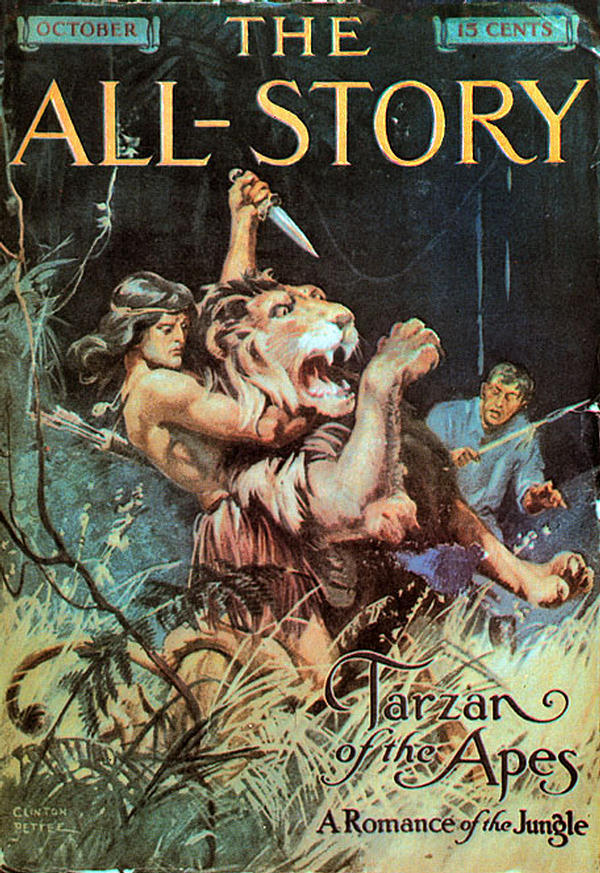
The All-Story, October 1912, cover by Clinton Pettee: Tarzan grappling with a lion — the first published image of Tarzan, from Tarzan of the Apes by Edgar Rice Burroughs.
The Most Iconic Pulp?The All-Story, October 1912 — Tarzan of the Apes, Edgar Rice Burroughs’s story, cover by Clinton Pettee: the first published image of Tarzan, and the most iconic pulp? Tap the cover to enlarge.

Explore the Volume, Page by Page

What began as one long page is now a small site. Each part of Volume One has its own page — and each magazine category has its own card below, so you can go straight to Adventure, Detective & Mystery, Love, Science Fiction, Sports, War & Aviation, Weird Tales & Horror, or Westerns without opening the Magazines index first.

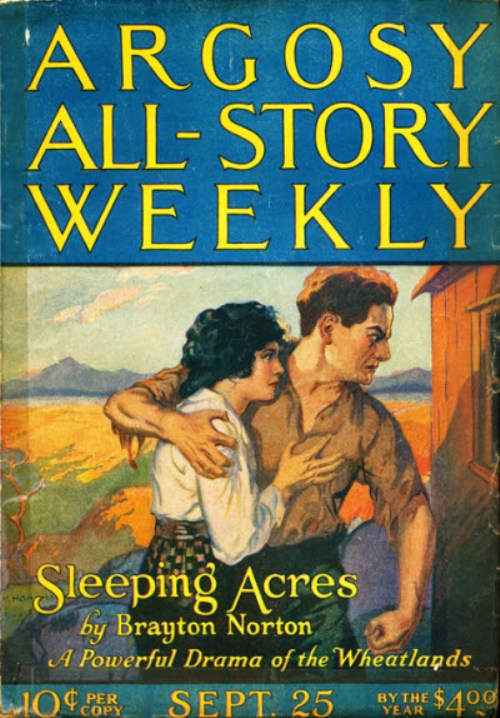
Argosy All-Story Weekly, September 25, 1920: a young couple embracing in wheatland country under a blue masthead.

Artist Index A–Z

55 artists · By artist, magazine & year

Every cover and interior artist in the volume, with reproductions, sample strips, and the magazines and years for each name.

Browse the index →
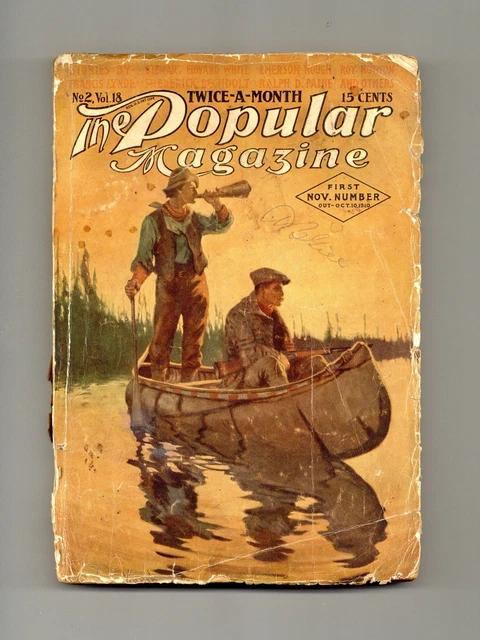
The Popular Magazine, November 1910: two men in a canoe on still water at sunset, one blowing a horn.

Pulp Magazines by Category

8 categories

The great titles, shelved the way collectors talk about them: Adventure (All-Story, Argosy, Blue Book, Adventure), Detective & Mystery, Love, Science Fiction on its own page, Sports, War & Aviation, Weird Tales & Horror, and Westerns.

Browse the categories →
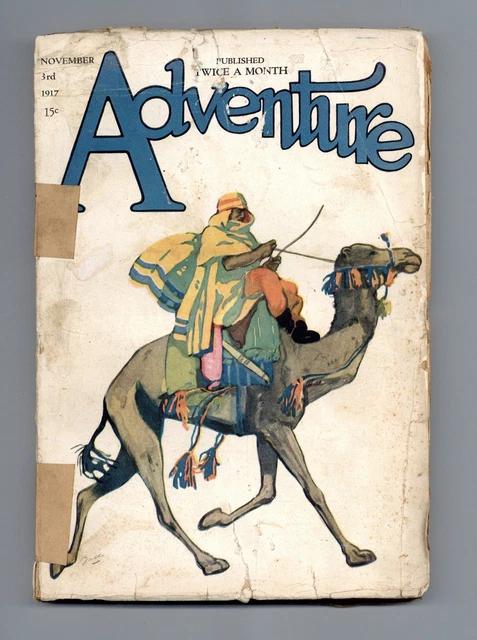
Adventure, November 3, 1917, cover by John R. Neill: a robed desert rider on a trotting camel.

Adventure

All-Story · Argosy · Blue Book · Adventure

The four adventure titles — plus The Popular Magazine and Short Stories, the other general-fiction giants — and the artists who filled them.

Browse the category →
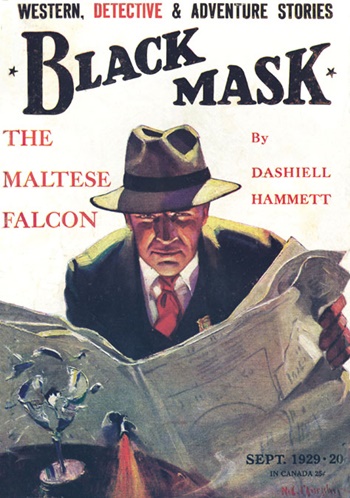
Black Mask, September 1929: a hard-faced man in a fedora reading a newspaper, a small falcon statuette below.

Detective and Mystery

Black Mask · Detective Story Magazine · Flynn’s · Clues

The first single-genre pulp (1915) and the home of the hard-boiled school under Joseph T. Shaw.

Browse the category →
Love Story Magazine, October 23, 1926, cover by Modest Stein: a young woman in a cloche hat, hands clasped.

Love

Love Story Magazine · Bacon’s other titles

The best-selling pulp of all time — Modest Stein’s covers and Daisy Bacon’s editorship, and the seven other Street & Smith titles she ran.

Browse the category →
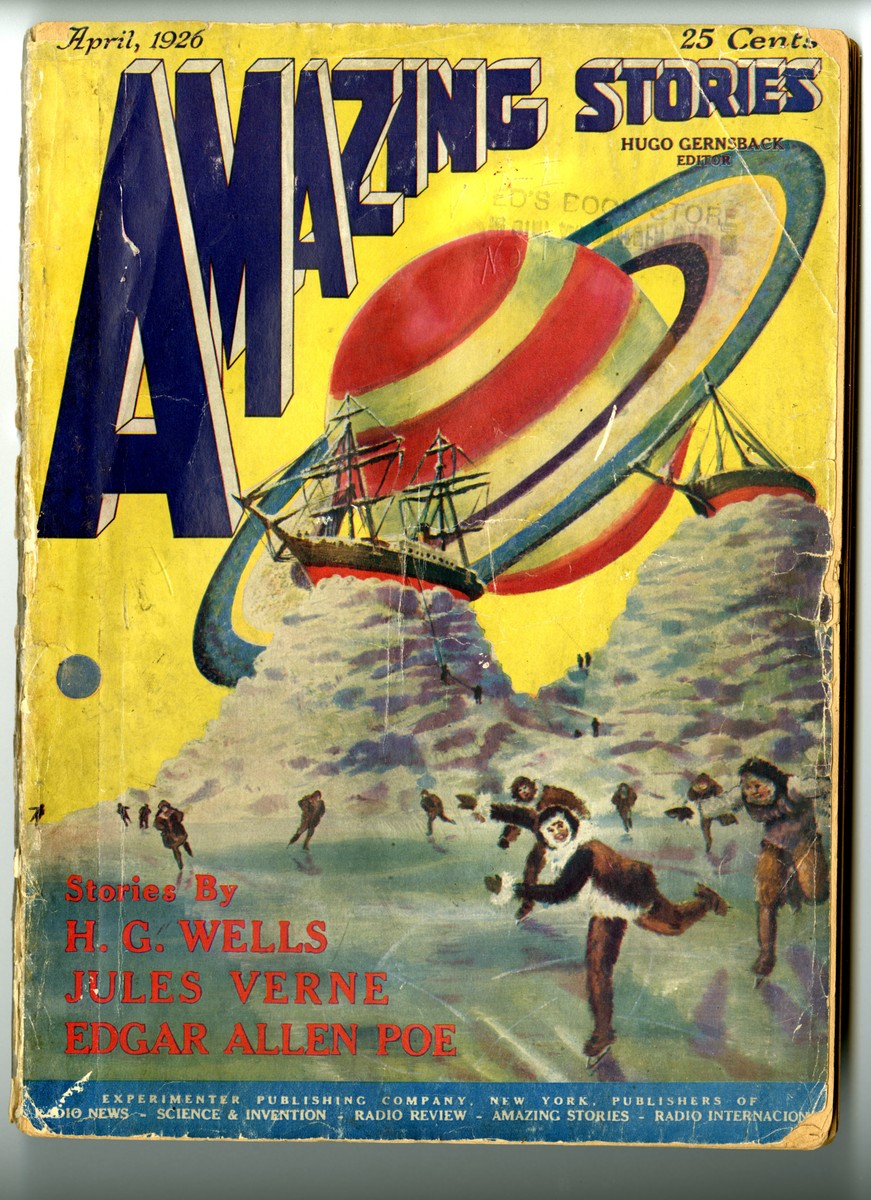
Amazing Stories, April 1926 — the first issue. Skaters on the ice of a ringed planet while a sailing ship sits stranded on a glacier, painted by Frank R. Paul.

Science Fiction

The other artists · 1912–1930

Beyond Frank R. Paul: Howard V. Brown picturing the future in Gernsback's technical magazines, the Burroughs illustrators' Mars, and Wesso and Leo Morey stepping in as Paul moved on — closing with the first Astounding cover, January 1930.

Meet them →
Fight Stories, September 1930, cover by Earle K. Bergey: a close portrait of a bare-shouldered young boxer, bruised and unsmiling.

Sports

Sport Story · Fight Stories

The first all-sports pulp (1923) and the boxing pulps from 1928, scoped to 1900–1930 — with Michelle Nolan’s McFarland histories of the sports pulps.

Browse the category →
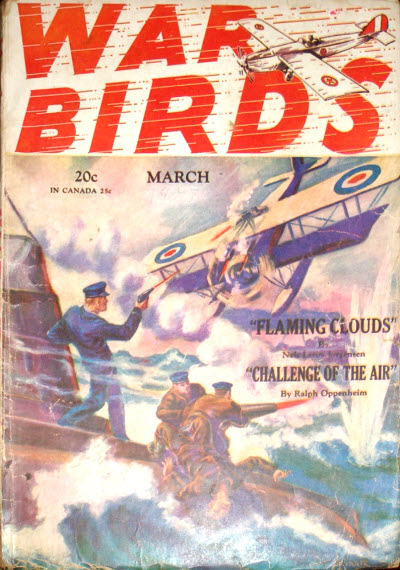
War Birds, No. 1, March 1928, cover by Chris Schaare: a British seaplane diving past a ship at sea.

War and Aviation

War Birds · War Stories · War Novels · Over the Top

Dell’s trench and air-war titles of 1928–1930 — the last cover market the twenties opened.

Browse the category →
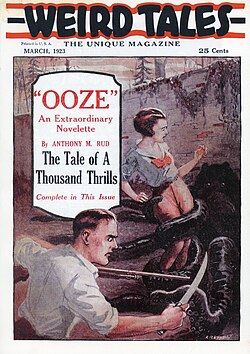
Weird Tales, March 1923, first issue, cover by Richard R. Epperly: a man with a knife fights a tentacled monster.

Weird Tales and Horror

Weird Tales · The Thrill Book · Ghost Stories

“The Unique Magazine” from its March 1923 first issue, and the horror pulps that travelled with it.

Browse the category →
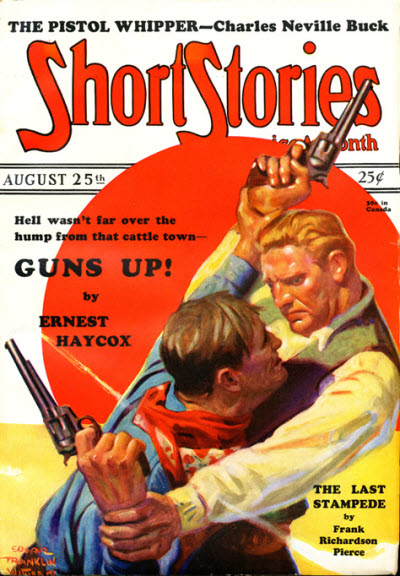
Short Stories, August 25, 1928: two men grappling, each holding a revolver, against a blazing red sun.

Westerns

Western Story Magazine · Cowboy Stories · Wild West Weekly

The first all-western pulp, from 1919 — thirty years and nearly 1,300 issues — with Cowboy Stories, Wild West Weekly, and the western side of Short Stories beside it.

Browse the category →
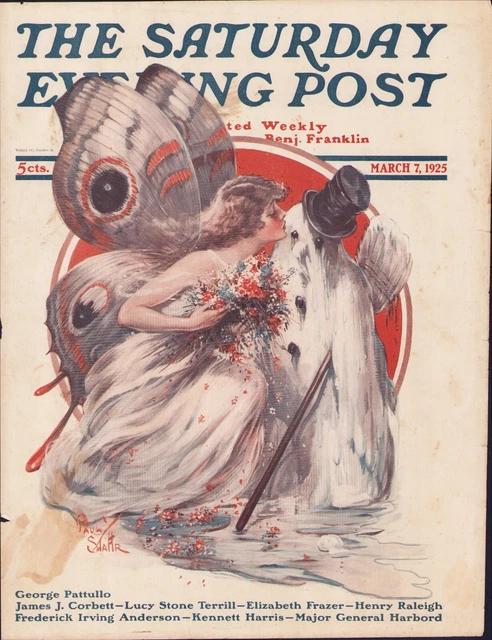
The Saturday Evening Post, March 7, 1925, cover by Paul Stahr: a butterfly-winged fairy kissing a melting snowman — Kissing Winter Goodbye.

Pulp Artists in the Slicks

Coll · Cornwell · Stahr

Artists from the main pulp index, shown in the slicks: Coll’s Fu Manchu and Professor Challenger for Collier’s, Cornwell’s Cosmopolitan paintings, and Stahr’s Saturday Evening Post covers.

See their slick work →
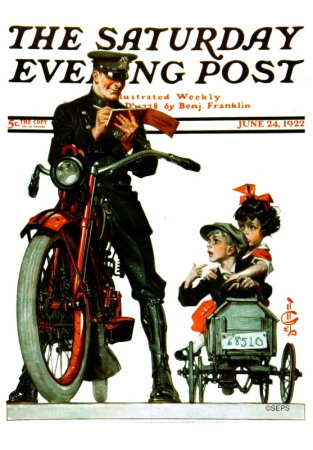
The Saturday Evening Post, June 24, 1922, cover by J. C. Leyendecker: a motorcycle policeman writing a ticket while two children in a toy car look on.

Slick Artists in the Pulps

Harvey Dunn · N. C. Wyeth

The famous slick-magazine illustrators who stepped down to pulp paper once or twice — Dunn and Wyeth, filed here on the strength of the pulp work itself.

Meet them →

Three Names to Know First

If you're new to the field, these three explain most of what a pulp cover was — and wasn't — between 1900 and 1930.

Frank R. Paul

1884–1963 · The science-fiction cover is born

Amazing Stories, April 1926, cover by Frank R. Paul: skaters on a ringed planet's ice with a sailing ship stranded on a glacier.
Amazing Stories — April 1926The first issue of the first science-fiction pulp.
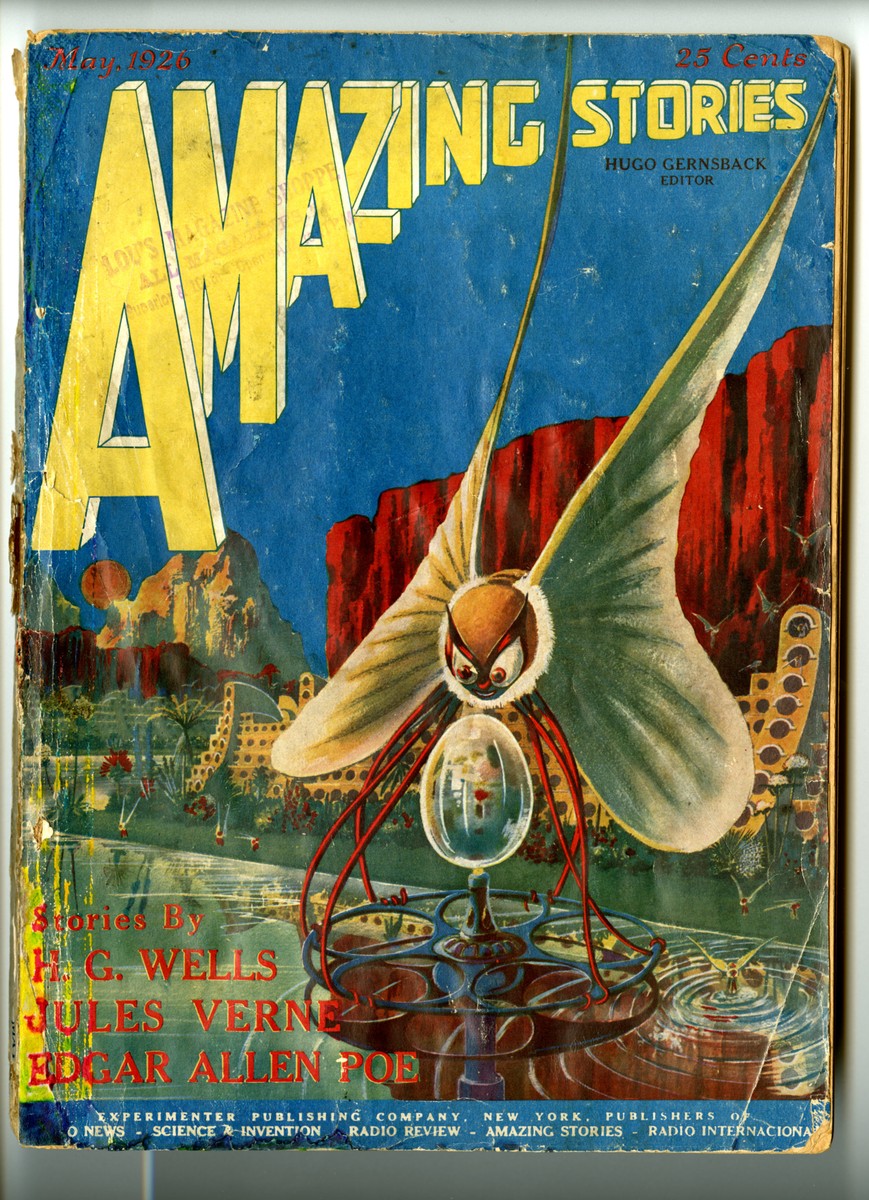
Amazing Stories, May 1926, cover by Frank R. Paul: a giant winged Martian creature over an alien landscape and lake.
Amazing Stories — May 1926The second issue: a winged Martian over an alien lake.
Amazing Stories, April 1927, cover by Frank R. Paul: a spiral of gears and the ages of human history winding inward to a starfield.
Amazing Stories — April 1927The “Spiral of Time” — all of history in one turning wheel.
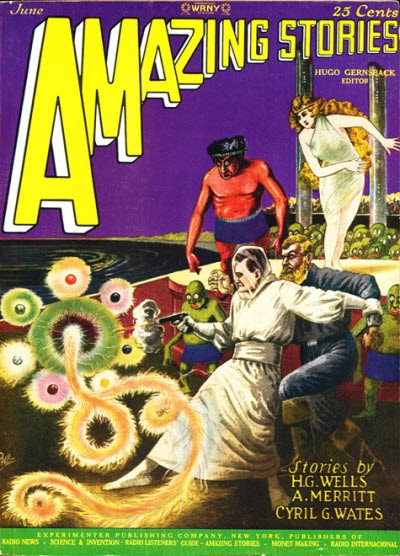
Amazing Stories, June 1927, cover by Frank R. Paul: a scientist with a pistol fights swirling eyeball creatures while aliens look on.
Amazing Stories — June 1927Eyeball creatures attack — Paul at his most lurid.
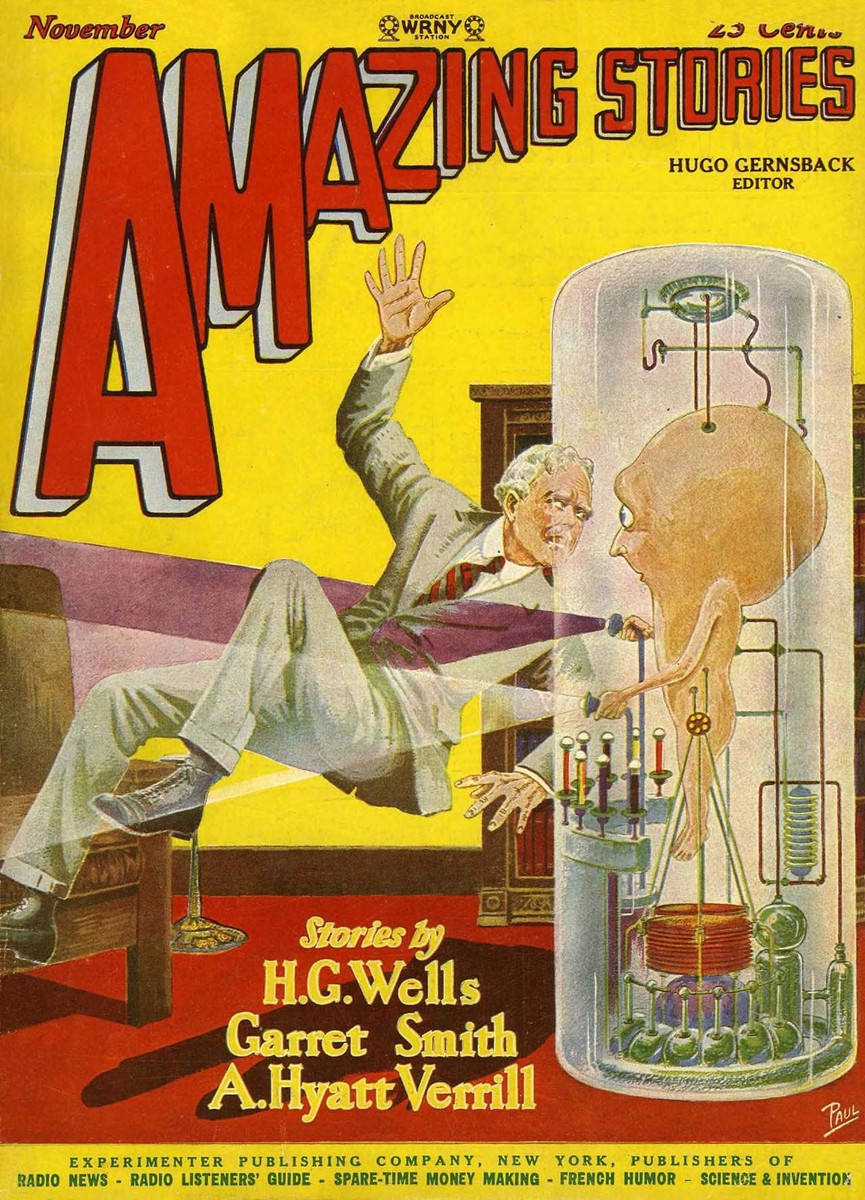
Amazing Stories, November 1927, cover by Frank R. Paul: a scientist recoiling from a huge-headed creature in a glass laboratory vessel.
Amazing Stories — November 1927A laboratory marvel in a glass tank.
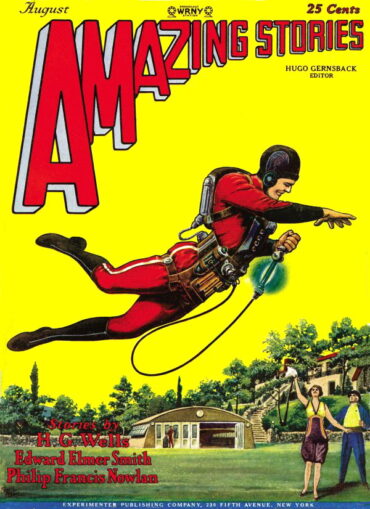
Amazing Stories, August 1928, cover by Frank R. Paul: a man in a red flight suit soaring on a rocket pack over a suburban home, trailing a cable, against a yellow sky.
Amazing Stories — August 1928A rocket-packed flier over the suburbs.

Hugo Gernsback hired Paul to paint Amazing Stories in 1926, and Paul painted every cover for its first three years — spaceships, alien landscapes, and future cities rendered with an architect's care for how the machine would actually work.

Before Paul, no magazine had a visual language for science fiction. After him, every one did.

J. Allen St. John

1872–1957 · The face of Tarzan

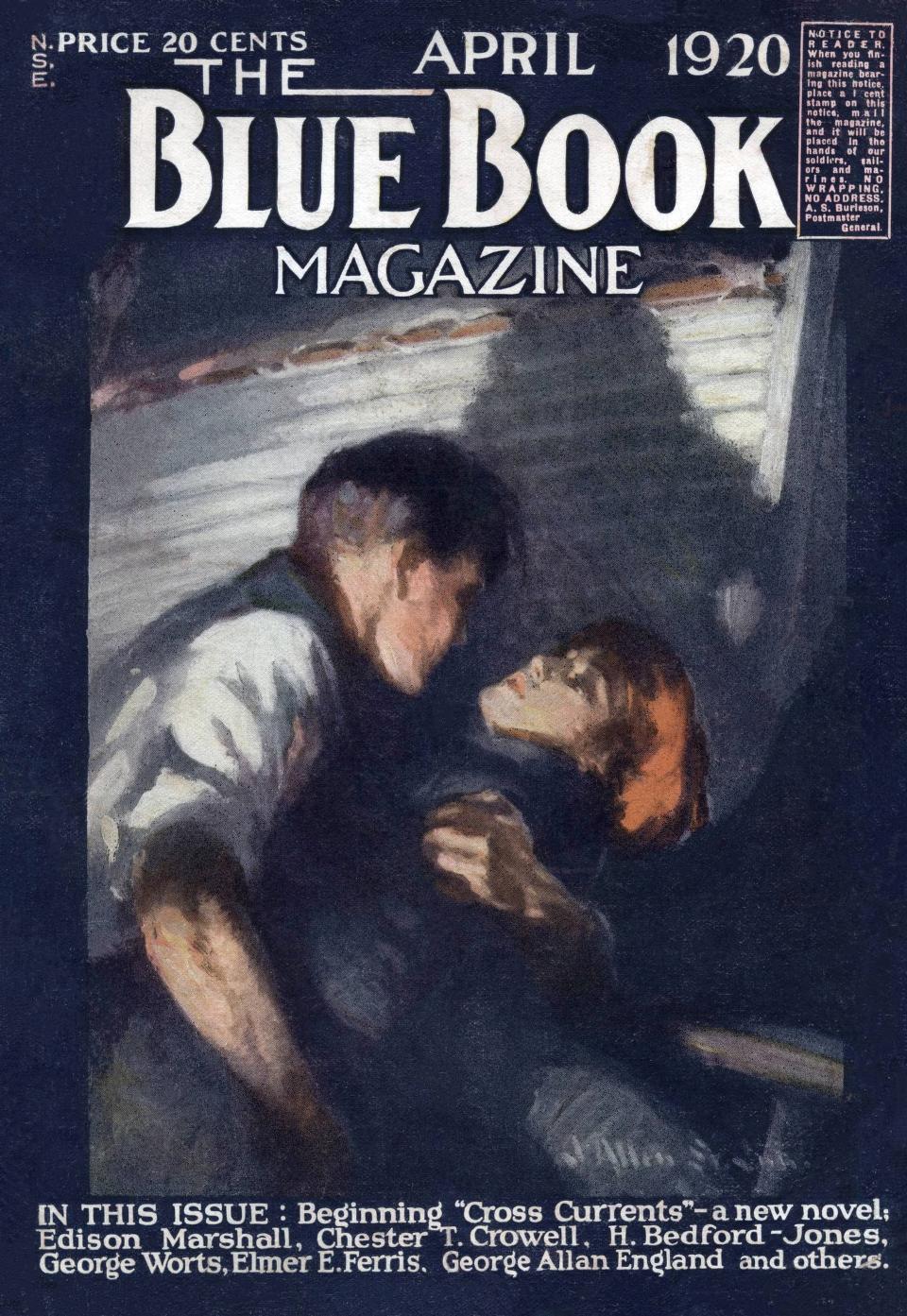
The Blue Book Magazine, April 1920, cover by J. Allen St. John, signed at lower right: a man holding a young woman in lamplight, for the opening of Cross Currents.
The Blue Book Magazine — April 1920Signed at lower right — “Cross Currents” begins.
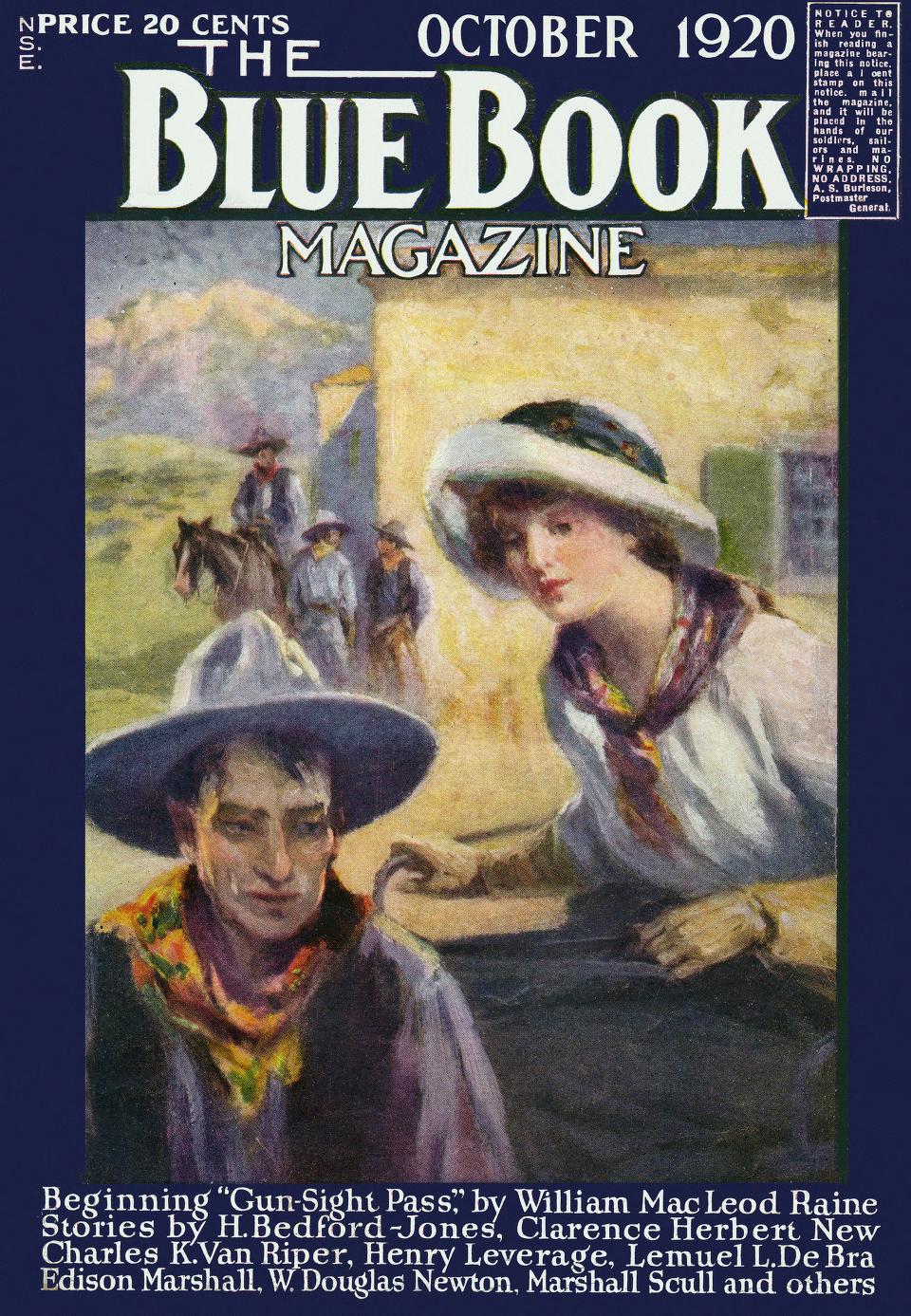
The Blue Book Magazine, October 1920, cover by J. Allen St. John: a young woman in a wide hat leaning toward a cowboy in the foreground, riders behind, for the opening of Gun-Sight Pass.
The Blue Book Magazine — October 1920“Gun-Sight Pass” begins.
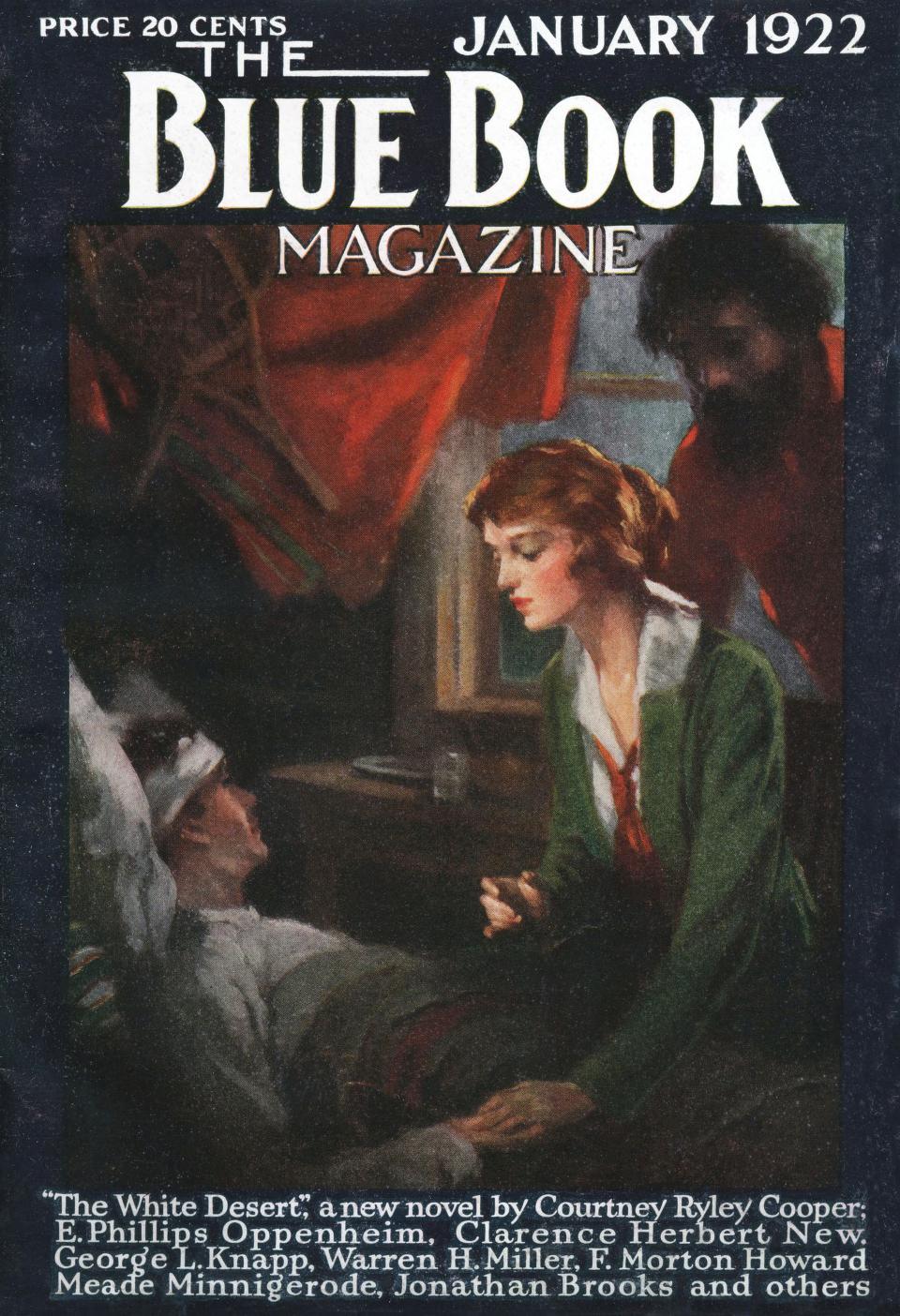
The Blue Book Magazine, January 1922, cover by J. Allen St. John: a young woman kneeling beside a bandaged man in bed, for The White Desert.
The Blue Book Magazine — January 1922Painted for “The White Desert,” credited to St. John in the issue itself.
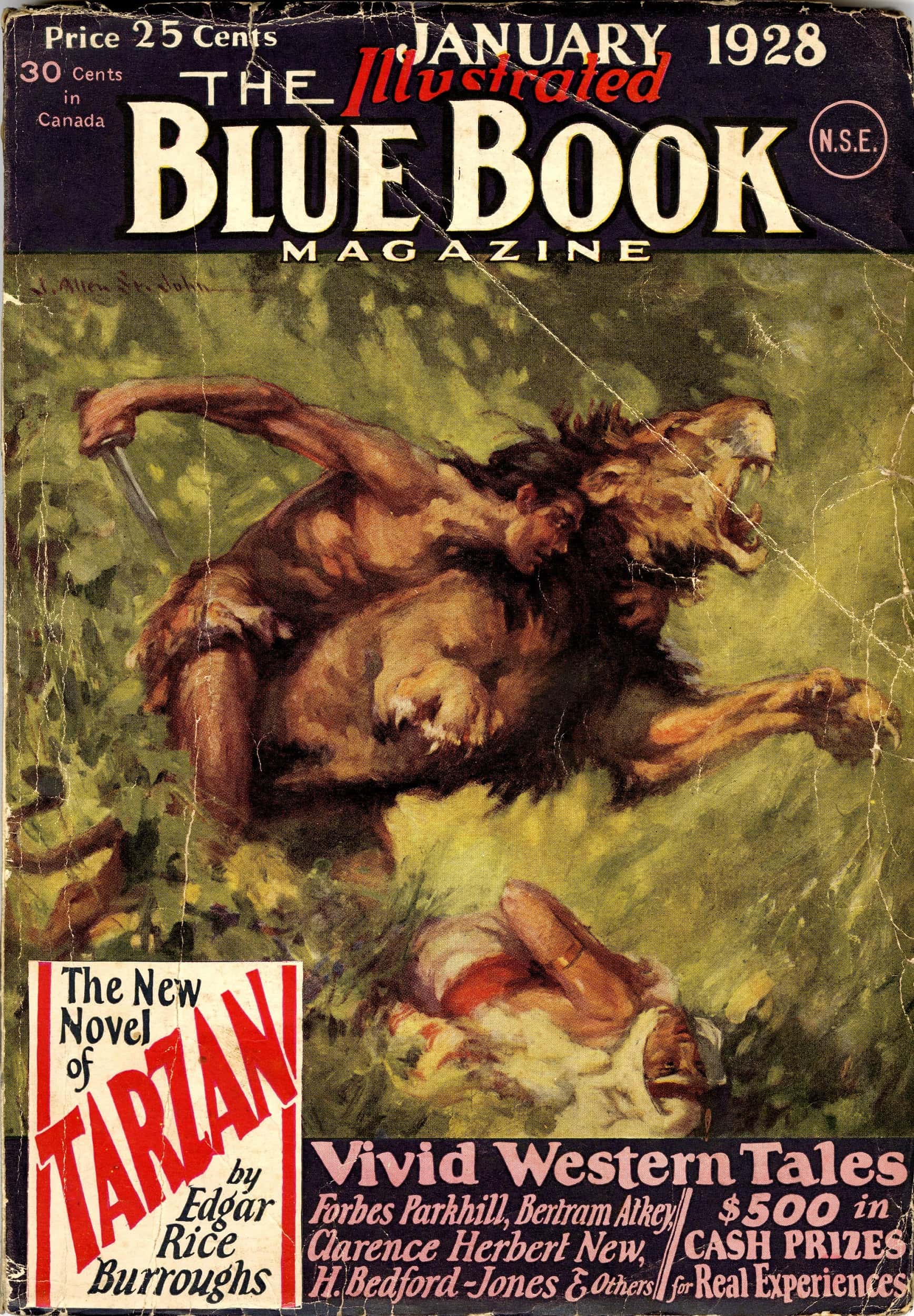
The Blue Book Magazine, January 1928, cover by J. Allen St. John: Tarzan grappling with a lion above a fallen woman, for Burroughs's new Tarzan novel.
The Blue Book Magazine — January 1928Tarzan grappling with a lion, for Burroughs’s new Tarzan novel.
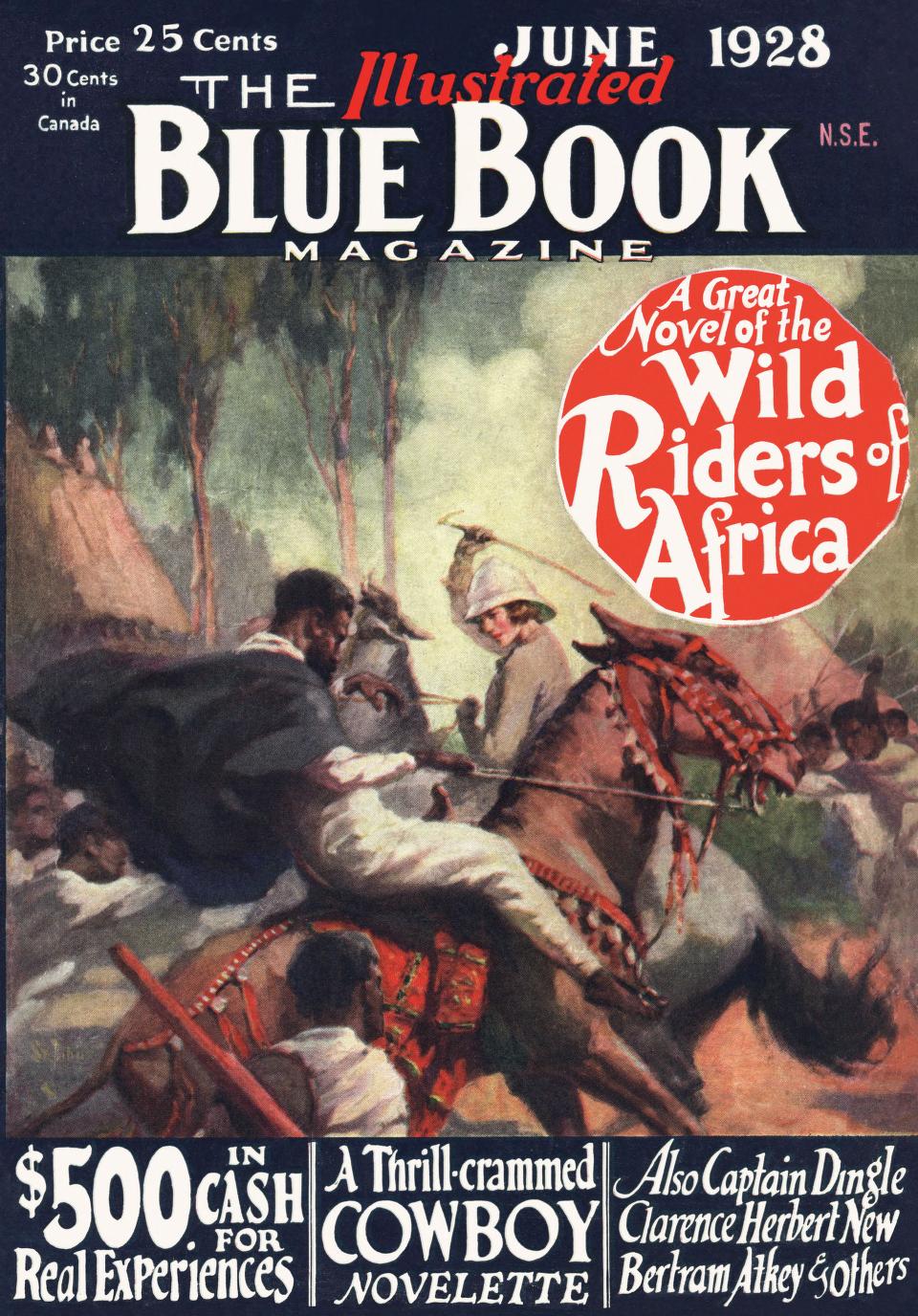
The Blue Book Magazine, June 1928, cover by J. Allen St. John: two horsemen fighting at full gallop, for Wild Riders of Africa.
The Blue Book Magazine — June 1928“Wild Riders of Africa.”
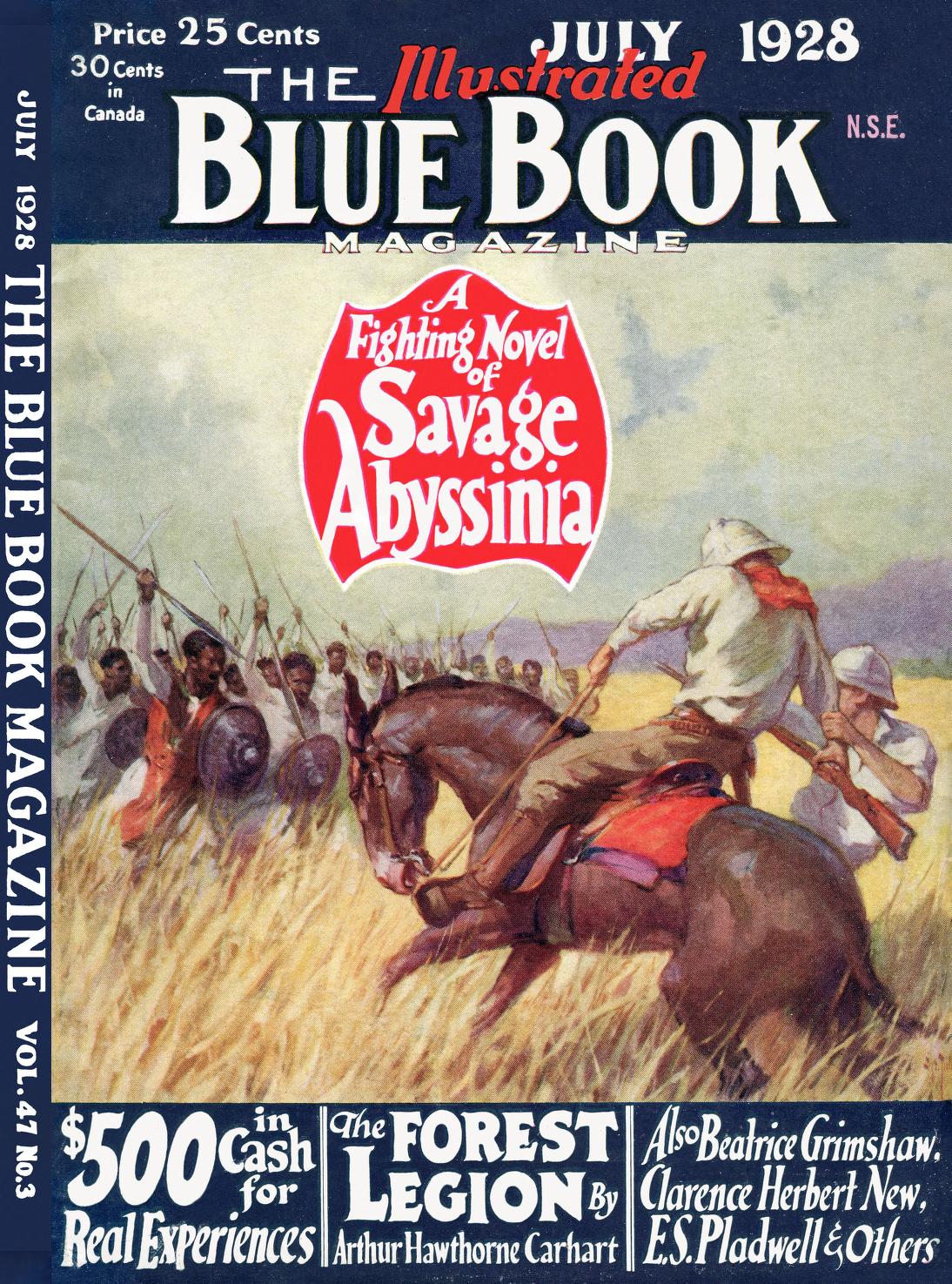
The Blue Book Magazine, July 1928, cover by J. Allen St. John: a horseman turning to face a line of spearmen in tall grass, for a fighting novel of Abyssinia.
The Blue Book Magazine — July 1928A fighting novel of “Savage Abyssinia.”

St. John became Edgar Rice Burroughs's defining illustrator — the artist whose Tarzan, John Carter, and Pellucidar images fixed those worlds in readers' minds, in the All-Story and Argosy serials and across the Burroughs books.

Trained as a painter, he brought a fine-art sense of anatomy and composition to the cheapest paper in America.

An honest note on the six above: St. John's Burroughs fame rests on the books — his pulp covers were few, and every one of these six is a Blue Book cover documented in the magazine's own pages or in the FictionMags, ISFDB, and Internet Archive records. Three more documented Blue Book covers — July 1921, October 1921, and June 1922 — are still to be sourced as scans. His Red Book and Green Book covers belong to the slicks, not this row.

Modest Stein

1871–1958 · The Love Story artist

All-Story Weekly, March 7, 1914, cover by Modest Stein: a Stone Age couple, for The Eternal Lover by Edgar Rice Burroughs.
All-Story Weekly — March 7, 1914Burroughs’s The Eternal Lover.
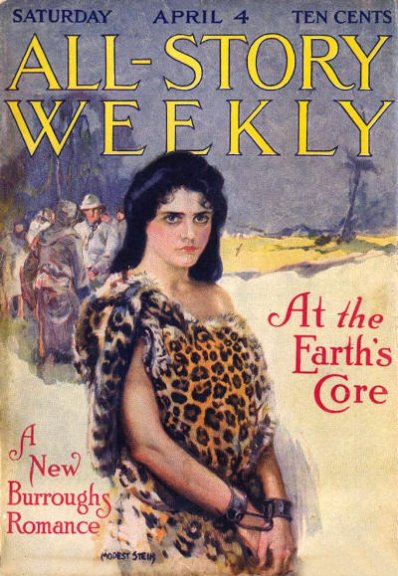
All-Story Weekly, April 4, 1914, cover by Modest Stein: a woman in a leopard-skin dress, for At the Earth's Core by Edgar Rice Burroughs.
All-Story Weekly — April 4, 1914At the Earth’s Core begins — the first Pellucidar story.
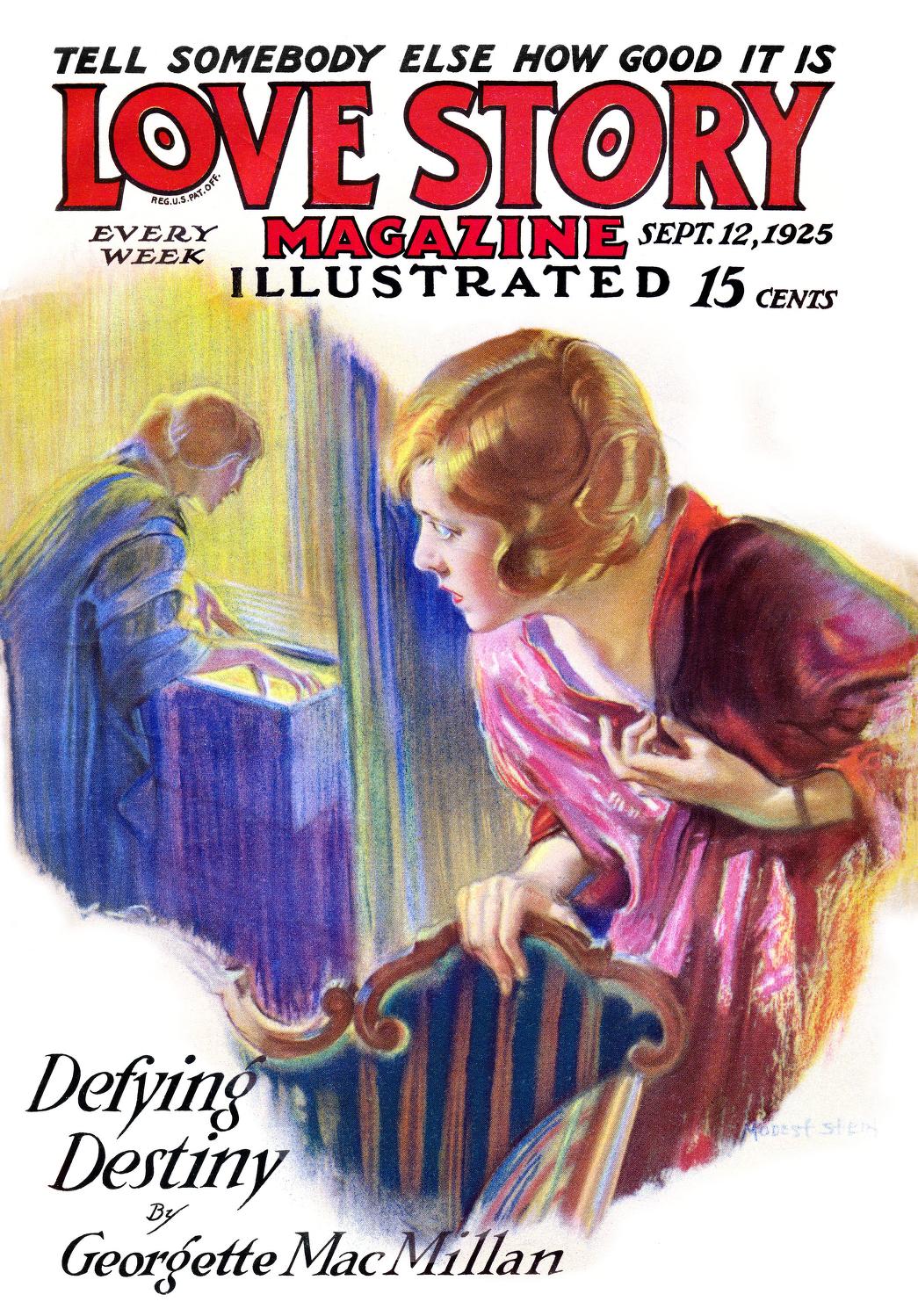
Love Story Magazine, September 12, 1925, cover by Modest Stein, signed at lower right: a young woman clutching her dress, watching a man at a desk, for Defying Destiny.
Love Story Magazine — Sept. 12, 1925Signed at lower right — “Defying Destiny.”
Love Story Magazine, October 23, 1926, cover by Modest Stein: a young woman in a cloche hat clasps her hands as a young man points at her from a garden gate.
Love Story Magazine — Oct. 23, 1926The best-selling pulp of all time in its fifth year.
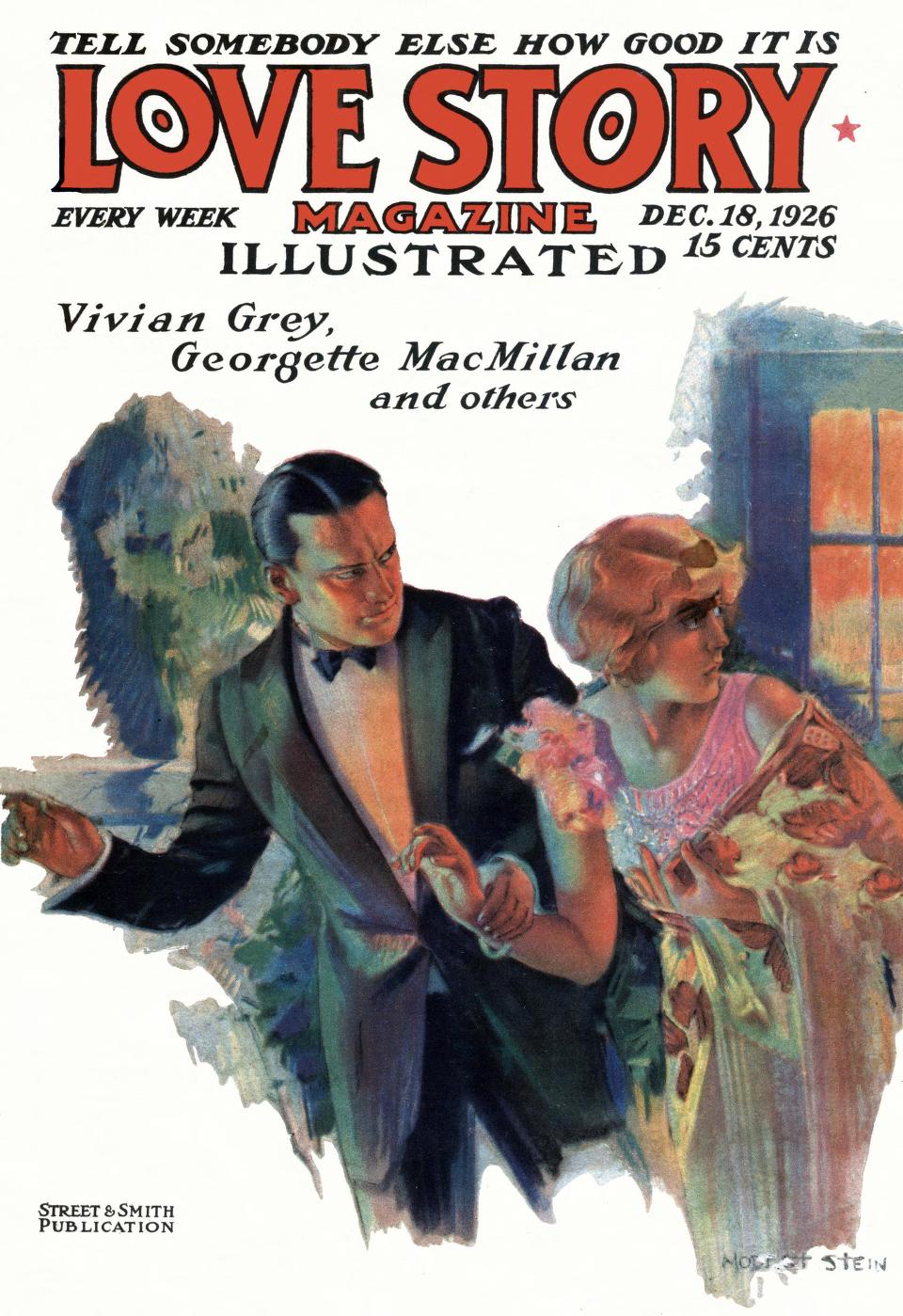
Love Story Magazine, December 18, 1926, cover by Modest Stein, signed at lower right: a man in evening dress holding a blonde woman's hand outside a lit window.
Love Story Magazine — Dec. 18, 1926Signed at lower right.
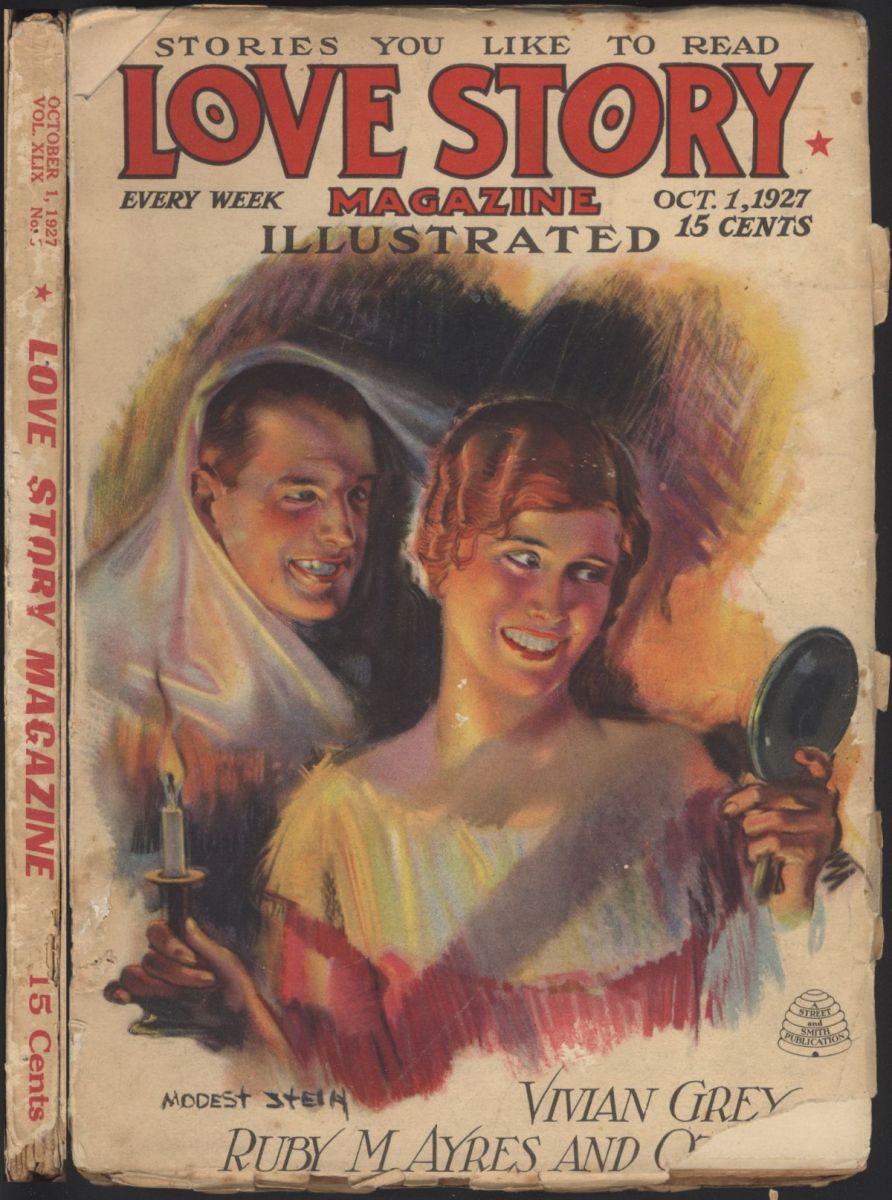
Love Story Magazine, October 1, 1927, cover by Modest Stein, signed at lower left: a smiling red-haired woman with a hand mirror, a man's face looming behind her.
Love Story Magazine — Oct. 1, 1927Signed at lower left.

Born Modest Aronstam in Kovno, Lithuania, Stein came to America at seventeen, made his name as a newspaper artist, and was selling pulp covers by 1910 — All-Story, Argosy, and The Cavalier among them, including the two 1914 Burroughs covers at the head of this row.

But his name belongs to one magazine above all: from 1922 he painted more than a hundred covers for Street & Smith's Love Story Magazine, the best-selling pulp of all time — PulpFest calls him, flatly, “the LOVE STORY artist.” Four of the six above are his signed Love Story covers.

Burroughs Covers

Edgar Rice Burroughs on the covers — Tarzan, John Carter, and Pellucidar, following his serials from The All-Story in 1912 through Argosy All-Story Weekly to Blue Book.

Friends of the Website

Two friends of this site lead the way in: first Ed Hulse, the pulp historian whose guides and journal have mapped the field for a generation, and then Matt Moring, whose Steeger Books reprints and PulpShelf catalogue keep the magazines in print and in order.

Cover of The Art of the Pulps: a red-haired pulp heroine beside a silver rocket ship blasting off above the Earth.
Caricature portrait of Ed Hulse today: a grinning man at a typewriter, drawn in black and white.

Ed Hulse · Murania Press

Editor of Blood ’n’ Thunder · Pulp historian

A leading pulp historian — his Blood ’n’ Thunder guides and histories, the journal he has edited since 2002, and the Murania Press reprint series.

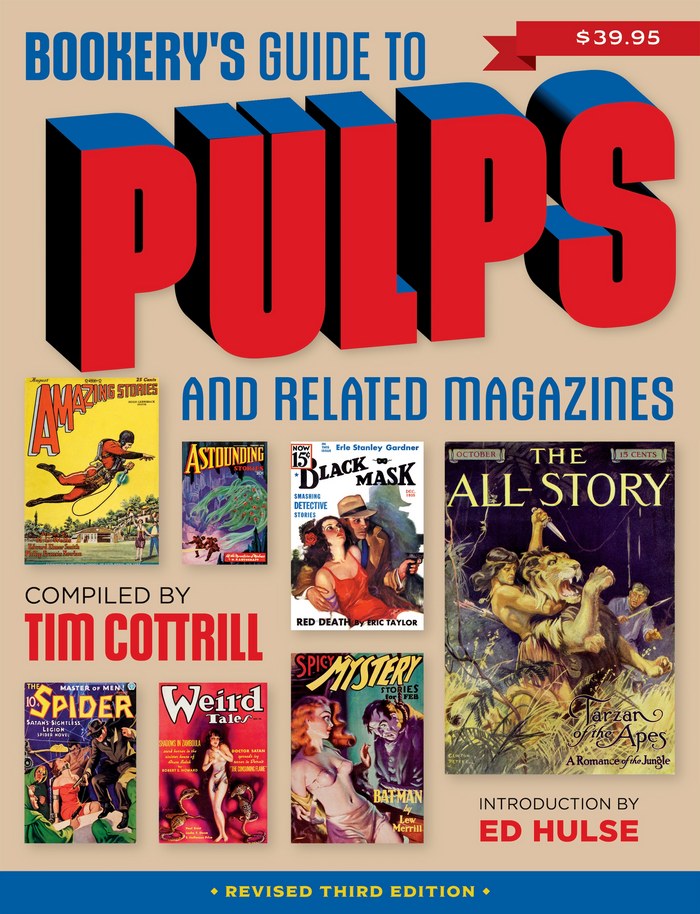
Cover of Bookery’s Guide to Pulps and Related Magazines, Revised Third Edition, compiled by Tim Cottrill with an introduction by Ed Hulse: the word PULPS in huge red block letters above a row of classic pulp covers.
Murania Press · 2025Bookery’s Guide to Pulps & Related Magazines, Revised Third Edition — by Tim Cottrill, introduction by Ed Hulse.
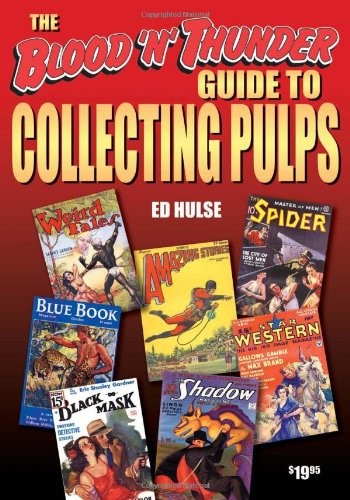
Cover of The Blood ’n’ Thunder Guide to Collecting Pulps by Ed Hulse: the title in bold red and yellow lettering above a fanned collage of classic pulp magazine covers.
Murania Press · 2007The Blood ’n’ Thunder Guide to Collecting Pulps — edited by Ed Hulse.
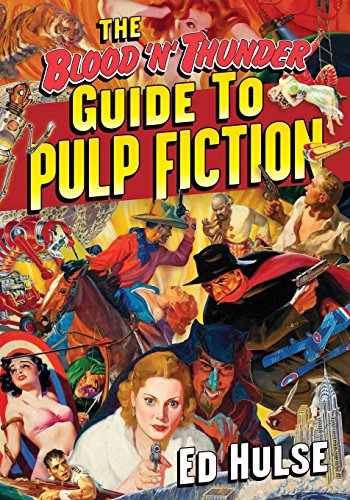
Cover of The Blood ’n’ Thunder Guide to Pulp Fiction by Ed Hulse: a collage of classic pulp cover paintings under bold yellow title lettering.
Murania Press · 2013The Blood ’n’ Thunder Guide to Pulp Fiction — edited by Ed Hulse.
Cover of The Best of Blood ’n’ Thunder, edited by Ed Hulse: a deep red cover with the title in bold white and red lettering, framed by covers of the Blood ’n’ Thunder journal itself.
Murania Press · 2011The Best of Blood ’n’ Thunder — edited by Ed Hulse.
Read his story →
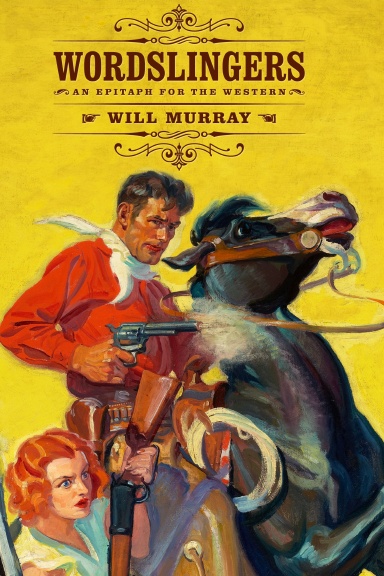
Cover of Wordslingers: An Epitaph for the Western by Will Murray: on a yellow field, a cowboy in a red shirt firing a revolver beside a rearing black horse, a red-haired woman holding a rifle below.
Painted-style portrait of Matt Moring today: a fair-haired man in a suit and tie against a cloudy sky.

Matt Moring · Steeger Books

Altus Press · PulpShelf · Complete-character reprints

The publisher who reinvented the pulp reprint: complete-character collections with the original covers and historians’ introductions, from Race Williams and Cardigan to Jo Gar. His page here also shelves Will Murray’s Wordslingers, placed in memory of its author.

Cover of Them That Lives By Their Guns, Race Williams Volume 1, by Carroll John Daly, Altus Press: a fedora-hatted detective in silhouette, smoking, a pistol in his hand, the title lettered in white across him.
Altus Press · 2015Race Williams, Vol. 1: Them That Lives By Their Guns — by Carroll John Daly. Tap the picture to enlarge.
Cover of The Camp-Fire, the complete correspondence from the pages of Adventure, 1918–1920, edited by Arthur Sullivant Hoffman: the title in white on a red ground over shadowy figures around a fire.
Steeger Books · 2023The Camp-Fire, 1918–1920 — the Adventure magazine letter column, edited by Arthur Sullivant Hoffman. Tap the picture to enlarge.
Cover of The Complete Exploits of the Notorious Sea Fox by James K. Waterman: a tall sailing ship under full canvas on a golden-brown sea.
Steeger Books · 2022The Complete Exploits of the Notorious Sea Fox — by James K. Waterman. Tap the picture to enlarge.
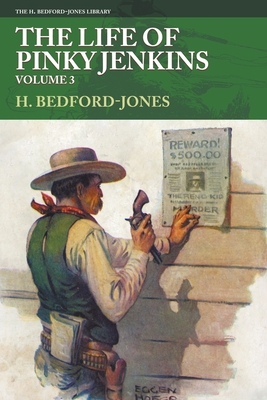
Cover of The Life of Pinky Jenkins, Volume 3, by H. Bedford-Jones, cover by Nick Eggenhofer: a Western sheriff in a hat and green vest, revolver in hand, reading a $500 reward poster pinned to a wall.
Steeger Books · 2022The Life of Pinky Jenkins, Volume 3 — by H. Bedford-Jones. Cover by Nick Eggenhofer. Tap the picture to enlarge.
Read his story →

Matt Moring · Steeger Books

PulpShelf

If this site answers who painted it?, PulpShelf answers what was published? Matt Moring — the Steeger Books publisher who brought Milton Shaw’s biography of his father, Black Mask editor Joseph T. Shaw, into print — has built a working catalog of the pulps themselves: 680 titles and more than 42,000 individual issues, with cover images, publication dates, and publishers for the run of each title.

Identifying a stray issue, checking how long a title ran, or simply browsing the newsstand of a century ago — this is the shelf to start from, and the natural companion to the artist index.
680pulp titles catalogued
42,000+individual issues listed

Mike Chomko · Mike Chomko Books

PulpFest · The Pulpster · Bookseller

Mike Chomko, winner of the 2010 Munsey Award, helped launch PulpFest in 2008 and serves as its marketing and programming director; he publishes The Pulpster and sells pulp books by mail order and at conventions.
Visit his site →

William Lampkin · ThePulp.Net

Founder · ThePulp.Net · Since 1996

William Lampkin founded ThePulp.Net in 1996, your link to the online world of the pulp magazines for over 30 years — pulp history, bibliographies, and news from the field.

Visit his site →

Audrey Parente · Pulp AdventureCon

Pulp Historian · Pulp Adventures · Pulp AdventureCon

Audrey Parente, an award-winning reporter turned pulp historian, writes biographies of pulp writers Hugh B. Cave, Judson Pentecost Philips, and Theodore Roscoe, edits Pulp Adventures, and helps organize Pulp AdventureCon.

Visit her site →

John Gunnison · Adventure House

Adventure House · High Adventure · Pulp Auctions

John Gunnison's Adventure House published High Adventure, the longest-running pulp reprint series in history, from 1991 through its 200th issue in 2025, along with facsimile replicas of classic pulps, and runs monthly online pulp auctions.

Visit his site →

Phil Stephensen-Payne · Galactic Central

Galactic Central · FictionMags Index · Illustrated Checklists

Phil Stephensen-Payne's Galactic Central holds tens of thousands of pulp magazine covers as illustrated checklists, and it hosts Bill Contento's FictionMags Index, with tables of contents for thousands of issues.

Visit his site →

Pulp Covers

The Best Of The Worst · Pulp Magazine Covers · Gallery

A gallery site devoted to pulp magazine covers, billed on the site itself as “The Best Of The Worst” — post after post of pulp covers to browse.

Visit the site →

Sai Shankar · Pulp Flakes

Blog · Pulp Magazines · Authors & Their Stories

Sai Shankar's blog about pulp magazines, authors, and their stories — in the site's own words, a look behind the scenes at the authors, editors, and illustrators behind the pulps, adventure and detective pulps especially, and the secrets of their storytelling.

Visit his site →