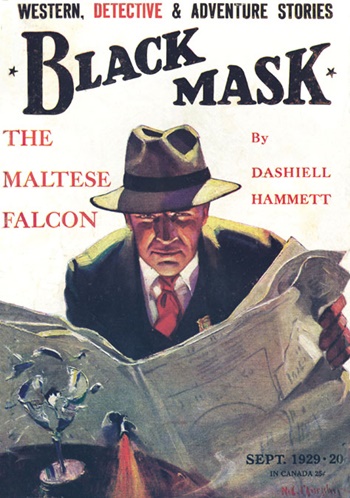
The covers in this index were painted to sell stories somebody else chose. At Black Mask, from 1926 to 1936, the chooser was Joseph Thompson Shaw — “Cap” Shaw, the nickname taken from his First World War captain’s rank. He was a soldier and a champion fencer before he was an editor, and he ran the magazine like both. Taking over with the November 1926 issue, he saw that the hard-boiled crime story Dashiell Hammett and Carroll John Daly were inventing could become a whole school of American fiction, and he built Black Mask around the men who wrote it — discovering Raymond Chandler along the way. The index’s Black Mask artists — Craft and Schlaikjer on the covers, Bowker inside, Murphy on the Maltese Falcon issue — were working for the magazine Shaw made. Asked in 1936 to cut his writers’ already meager pay, he refused, and resigned. No book told his full story until his own son wrote one.
Cover · Black Mask, September 1929Henry C. Murphy, Jr.’s cover for the first instalment of The Maltese Falcon — the magazine Shaw made, at its height. Tap the picture to see it larger.
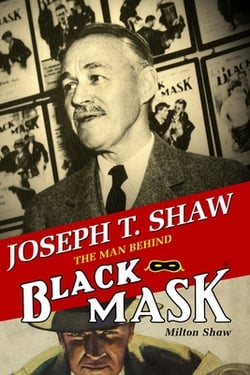
Cover of the biography — Shaw himself at the Black Mask office in the early-to-mid 1930s, his magazine’s covers framed on the wall behind him. Cover image courtesy of the publisher, Steeger Books.
Joseph T. Shaw
The Man Behind Black Mask
By Milton Shaw
Milton Shaw wrote the first biography of his own father, drawing on his own extensive research, on family knowledge no archive holds, and on never-before-published correspondence between Shaw and his writers. He did not live to see it in print. It reached readers in 2019 through Steeger Books, the publishing house of Matt Moring — pulp publisher, keeper of the Black Mask library in print, and a friend of this site — which makes this section a thank-you as well as a book note: the editor’s son wrote the story, and Matt brought it to the world. Matt also keeps PulpShelf, his catalog of vintage pulp magazines — 680 titles and more than 42,000 issues, with cover images, publication dates, and publishers — the shelf, so to speak, behind the reprints.
The book follows Shaw from Gorham, Maine, through his soldiering and fencing to the editor’s chair, but its heart is the Black Mask decade: how he pulled the magazine back from the brink of cancellation, the stable he built — Hammett, Chandler, Daly, Nebel, Gardner, Whitfield, Dent — and more than a hundred pages of his letters to and from his writers, printed here for the first time. It closes with the years after Black Mask: Shaw the writer and literary agent, and his 1946 anthology The Hard-Boiled Omnibus, the first collection of the school he had created.
Steeger Books · 2019 · 320 pages · 6 × 9 in · Softcover ISBN 978-1-61827-419-9 · Also in hardcover and as an ebook
“Joe ‘Cap’ Shaw has become an almost mythic figure in the history of hardboiled fiction… Now, at last, we have a book-length study devoted to Joe himself, written by none other than his son Milton Shaw. The book was obviously a labor of love, and is the closest we will ever come to knowing the man behind the legend.”
Reader review · Goodreads
“The author has done a fine job of gathering anecdotes and analysis from multiple sources, adding never-before-seen correspondence between Joe and his writers, and enriching it all with his own extensive research and personal insight.”
Reader review · Goodreads
“In the first biography ever written of this editorial giant, his son relates the full fascinating story of the man behind the revolutionary editorial persona.”
Steeger Books · the publisher
“It’s Joseph T. Shaw, from beginning to end, with lots of good stuff in between. If you’re a Black Maskian like me, this book is required reading.”