1900–1930, in brief
The pulp era doesn't start with a bang — it accumulates, one launch at a time, until by 1930 there is a specialized magazine for nearly every kind of story.
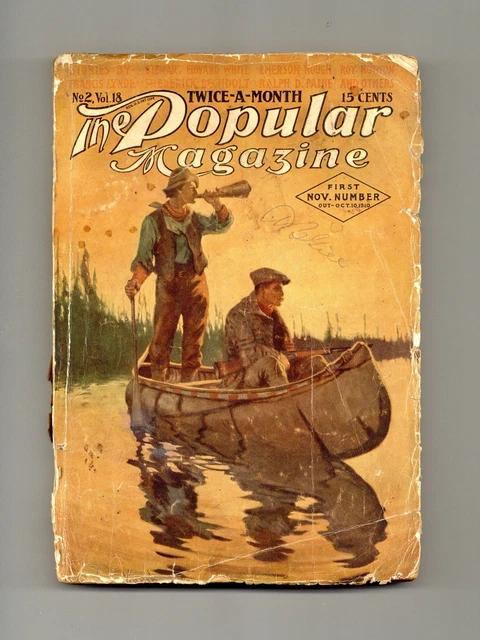
1903The Popular Magazine launches
Street & Smith's flagship general-fiction pulp — and a steady market for Frank Schoonover, J.C. Leyendecker, and a generation of adventure illustrators.
1905All-Story and Blue Book appear
Munsey's All-Story Magazine and the Blue Book join the field. Within a decade All-Story will publish a first novel by a former Chicago railroad-yard night operator named Edgar Rice Burroughs.
1910Adventure is founded
Arthur Sullivant Hoffman's Adventure becomes the prestige adventure pulp — the magazine writers and artists alike wanted to be in, and a proving ground for cover painters including the young Walter Baumhofer.
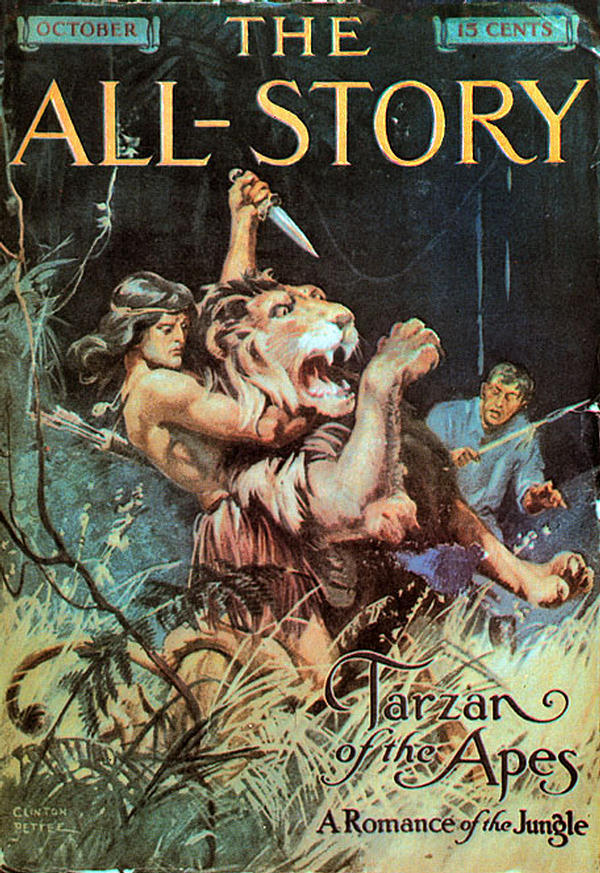
1912Tarzan swings in
Tarzan of the Apes runs complete in the October 1912 All-Story. Burroughs becomes the pulps' biggest serial property — and J. Allen St. John becomes his artist.
1919The Thrill Book tries the weird first
Street & Smith's The Thrill Book mixes weird and fantastic tales four years before Weird Tales — and folds within the year. The audience was there; the timing wasn't, quite.
1920Two landmarks in one year
Argosy and All-Story merge into Argosy All-Story Weekly, the era's giant. The same year, H.L. Mencken and George Jean Nathan launch The Black Mask — the detective pulp that will change American crime fiction.
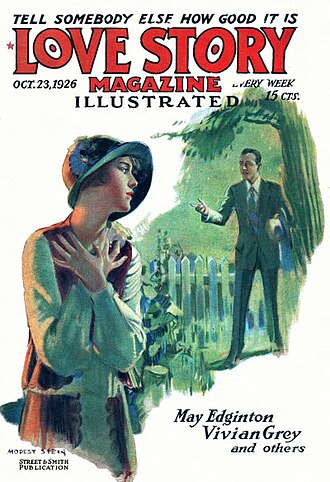
1921Love Story invents the romance pulp
Street & Smith's Love Story Magazine launches in May and becomes the best-selling pulp of all time — circulation climbing toward 600,000 by the decade's end, with Modest Stein painting its covers from 1922.
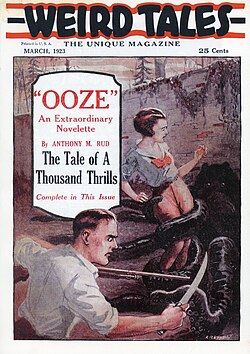
1923Weird Tales is founded
“The Unique Magazine” gives horror and weird fantasy a home of their own — Richard R. Epperly paints the March 1923 first cover — publishing Lovecraft, Howard, and Smith through the decade on a shoestring. Macfadden's Ghost Stories follows in 1926, selling first-person hauntings as true experiences.
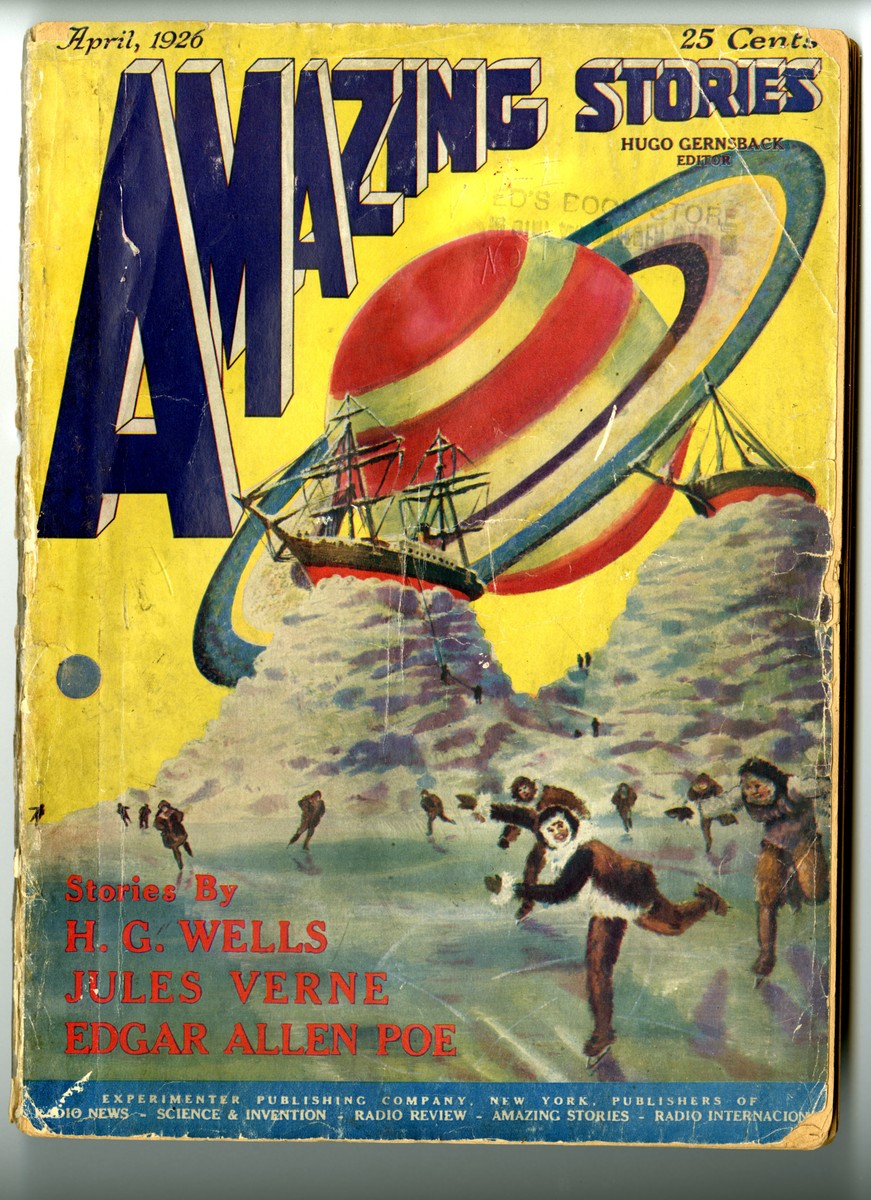
1926Amazing Stories invents a genre's look
Hugo Gernsback launches the first all science-fiction pulp, with Frank R. Paul painting the covers. A category that had lived inside general pulps now has its own magazine — and its own art.
1929–30The specialists multiply — and the volume closes
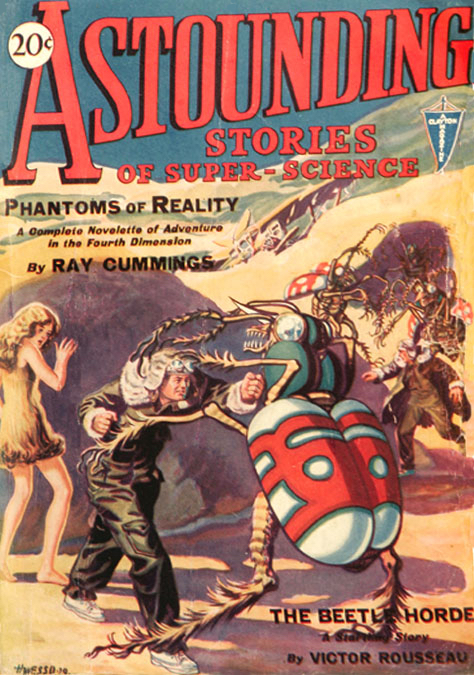
Gernsback adds Science Wonder Stories and Air Wonder Stories (1929); Dell's war pulps put Rudolph Belarski to work; and in January 1930 Astounding Stories arrives, closing the volume's final year. Everything after 1930 belongs to Volume Two — where the copyright picture gets more complicated.
Copyright, in plain terms
This is general information about how U.S. copyright treats old magazines — not legal advice. It explains why this volume is built the way it is, and what changes the moment the catalog moves past 1930.
1Why 1900–1930 is clear
U.S. works published in 1930 or earlier are in the public domain. Their 95-year copyright terms have all run out — the 1930 works entered the public domain on January 1, 2026.
That covers the whole issue: the cover painting, the interior illustrations, and the stories. You may reproduce them at full size, for free or commercially, without asking anyone.
2The artists usually didn't own the art
Pulp art was normally work for hire: the publisher bought the painting outright and owned the copyright, not the artist. That's why this index credits artists by name as a matter of scholarship, even though permission — where it was ever needed — would have run through publishers.
For public-domain years it changes nothing in practice. It matters a great deal in later volumes, when you're looking for a rights holder.
3What public domain does not clear
- Trademarks. A magazine title can still be a live trademark. Naming an issue — “cover from Weird Tales, Feb. 1924” — is fine descriptive use. Branding your own product with that title or logo is not.
- Other people's scans. A faithful scan of public-domain art creates no new copyright in the scan itself, but be a good citizen: scan your own copies where you can, and credit sources where you can't.
- Other countries. This page follows U.S. law. Terms differ abroad, usually based on the artist's death date.
4What changes in Volume Two (1931 on)
- Works from 1931–1963 had to be renewed after 28 years or they fell into the public domain. Many pulps were never renewed — but it has to be checked title by title in the Copyright Office records.
- Works from 1964 on renewed automatically: assume they're still copyrighted.
- For still-copyrighted issues, the safer pattern is small identifying thumbnails inside a factual, commented index — never full-size art without permission.
- Keep a note of every check you run, publish a contact address, and take an item down promptly if a rights holder writes. That routine resolves nearly every dispute a small archive will ever meet.
House rules for this index, following from the above: Volume One reproduces covers at full size because every issue in it is public domain in the United States. Artist credits are given wherever they are documented — a signature on the painting, a magazine credit line, or a reliable index — and left open where they aren't, rather than guessed. If you hold rights in anything shown here and believe it is misclassified, the right response to a note saying so is a prompt correction, and this index is written to make that easy.
The volumes ahead
One volume per era, each with its own copyright footing — so the collection can grow without ever mixing clear material with material that needs checking.
Volume One · 1900–1930
This volume · Public domain
The founding decades: general-fiction giants, the first detective, weird, and science-fiction pulps, and the Howard Pyle school's march onto cheap paper.
Volume Two · 1931–1939
Planned · Renewal checks required
The hero pulps, Margaret Brundage, Virgil Finlay, and the weird menace boom. Every title gets a renewal check before a cover goes up at full size. Already queued for this volume: Herbert Morton Stoops, whose famous Blue Book covers ran from 1935 until his death in 1948 — his 1920s work was interiors for the slicks, so he belongs here, not in Volume One. Also queued: the romance pulps at their peak — Love Story Magazine's 1930s and 1940s, with Stein painting into the 1940s and John Newton Howitt, Zoe Mozert, and J. Clark Work among its cover artists.
Volume Three · 1940–1949
Planned · Renewal checks required
War-era pulps, the paper drives, and the last great decade of the painted cover before the paperback took the newsstand.
How a new entry gets added
- Artist first:
Artist name (birth–death)— filed alphabetically by surname. - Then magazine: every title they worked for, A–Z, with the years inside the volume.
- Then the work: cover, interior, or both — and the specific issue where it's documented.
- Then the evidence: signature, credit line, or index source for the attribution. No evidence, no credit — the entry says “artist not yet identified.”
- Then the scan: your own scan where possible, with the source noted either way.