Horror stands as its own category: Weird Tales, “The Unique Magazine,” first and last — with its two fellow travellers, Street & Smith’s The Thrill Book (1919) and Bernarr Macfadden’s Ghost Stories (1926–1932), each given its own sub-entry below. Lovecraft, Howard and Clark Ashton Smith lived here, and so did a small, distinctive bench of cover artists.
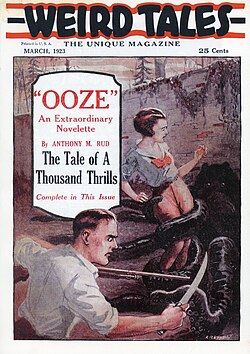
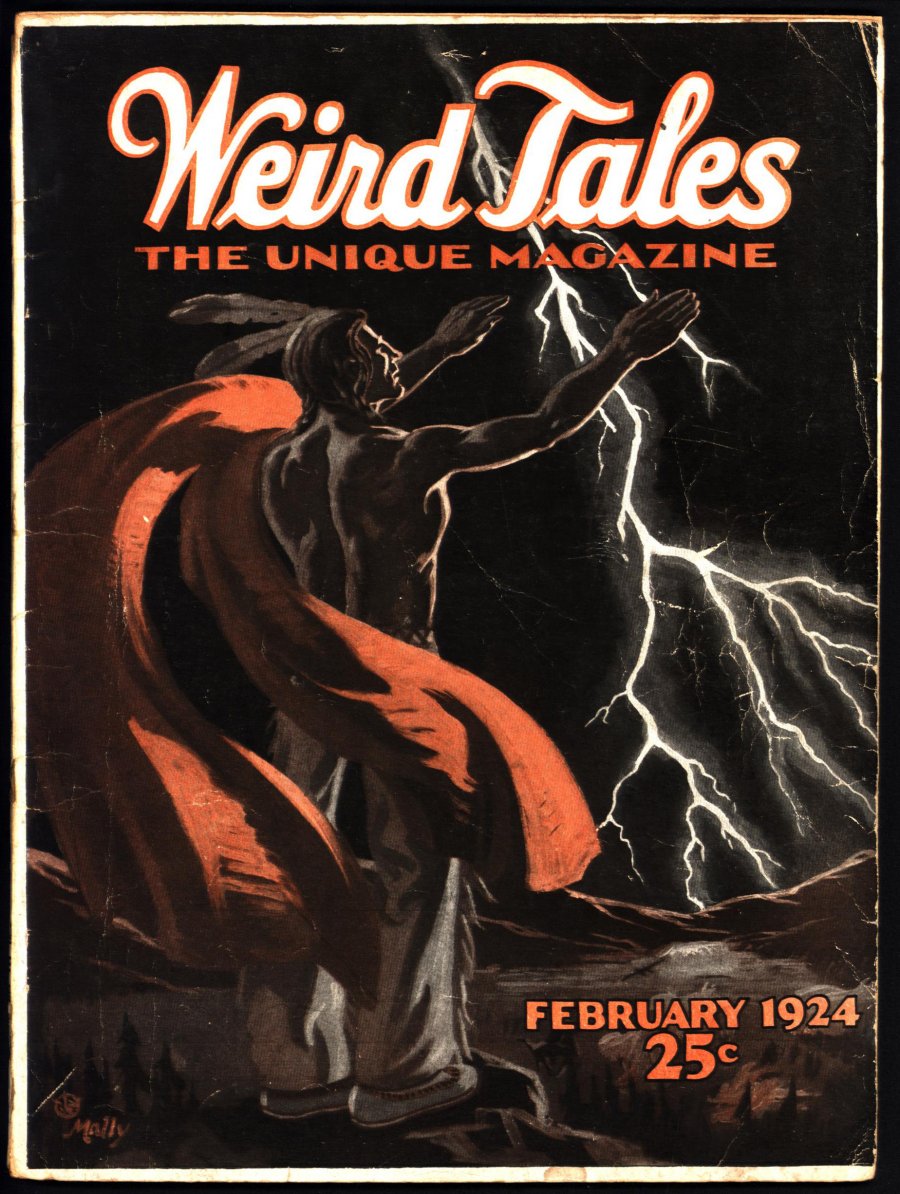
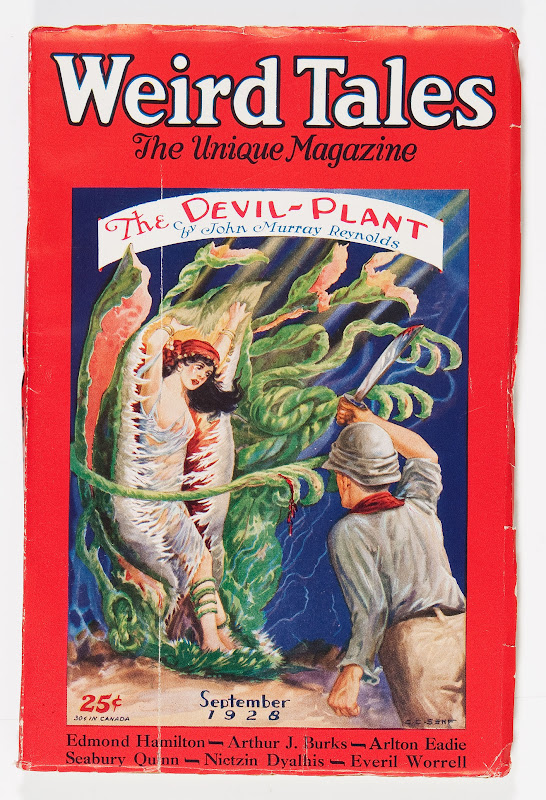
March 1923 · First issueR. R. Epperly’s “Ooze” cover launched “The Unique Magazine.” Tap the picture to see it larger.February 1924Lightning, a storm, and a figure in a sweeping red cloak. Tap the picture to see it larger.Sept. 1928 · C. C. Senf“The Devil-Plant” — Senf in the middle of his 45-cover run. Tap the picture to see it larger.
Weird Tales — Horror & the Weird
From 1923 · Horror, weird & ghost stories · “The Unique Magazine”
Horror needed its own home, and it got two tries before it stuck. Street & Smith's The Thrill Book (1919) mixed weird and fantastic tales four years early and folded within the year. Weird Tales, launched in March 1923, was the one that lasted — “The Unique Magazine,” publishing Lovecraft, Robert E. Howard, and Clark Ashton Smith on a shoestring. From November 1924 the man choosing those stories was Farnsworth Wright — sixteen years, 179 issues, and the Three Musketeers of weird fiction; his page sits with this site’s other great editors, beside Daisy Bacon and Joseph T. Shaw. Bernarr Macfadden's Ghost Stories (1926–1932) took the other road to the same reader: true-style, first-person ghost accounts, told as if they had happened to the narrator.
Its artists in this indexRichard R. Epperly — the very first cover, March 1923 · Andrew Brosnatch — 1925 covers and the art for “The Eyrie,” the magazine's letter column · E. M. Stevenson — the September 1926 cover · C. Barker Petrie Jr. — the October 1926 cover · C. C. Senf — 45 covers from 1927 · Hugh Rankin — 15 covers from 1927, signing some “DOAK.” · William Fred Heitman — June 1923, in the magazine's first months, and his illustration for Lovecraft's “The Hound,” February 1924
Example cover
No cover of The Thrill Book is reproduced in this volume yet — a public-domain scan from 1930 or earlier is still to be sourced for this box. Identifications welcome.
The Thrill Book
Street & Smith · 1919 · Weird & fantastic · The first try
Four years before Weird Tales, Street & Smith tried a pulp of the weird and fantastic: The Thrill Book mixed weird tales, fantasy, and adventure in 1919 — and folded within the year. It proved the appetite was there before anyone had found the formula; Weird Tales, in 1923, found it. The title is filed here, with the horror pulps it anticipated, rather than given a category of its own.
Its artists in this indexIts cover artists are not yet pinned down in this index — identifications welcome
Example cover
No cover of Ghost Stories is reproduced in this volume yet — a public-domain scan from 1930 or earlier is still to be sourced for this box. Identifications welcome.
The other road to the same reader: Bernarr Macfadden’s Ghost Stories printed first-person ghost accounts told as if they had really happened to the narrator — the “true story” formula Macfadden had built an empire on, turned to hauntings. It ran from 1926 to 1932, alongside Weird Tales’ fiction for most of this volume’s last years.
Its artists in this indexIts cover artists are not yet pinned down in this index — identifications welcome