The covers in this index were painted to sell stories somebody else chose. At Weird Tales, from November 1924 to March 1940, the chooser was Farnsworth Wright (1888–1940) — and he takes his place among this site’s historically significant pulp editors: Joseph T. Shaw built the hard-boiled school at Black Mask, and Daisy Bacon ruled romance at Love Story, while Wright made “The Unique Magazine” the home of weird fiction. He edited 179 issues, and at the center of them stood the three writers readers still call the Three Musketeers of Weird Tales — H. P. Lovecraft, Clark Ashton Smith, and Robert E. Howard. Jack Williamson, himself one of Wright’s authors, called him “the first great fantasy editor.”
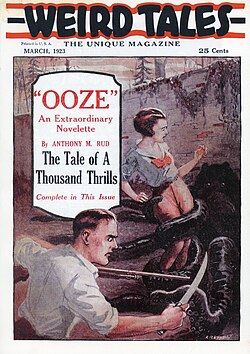
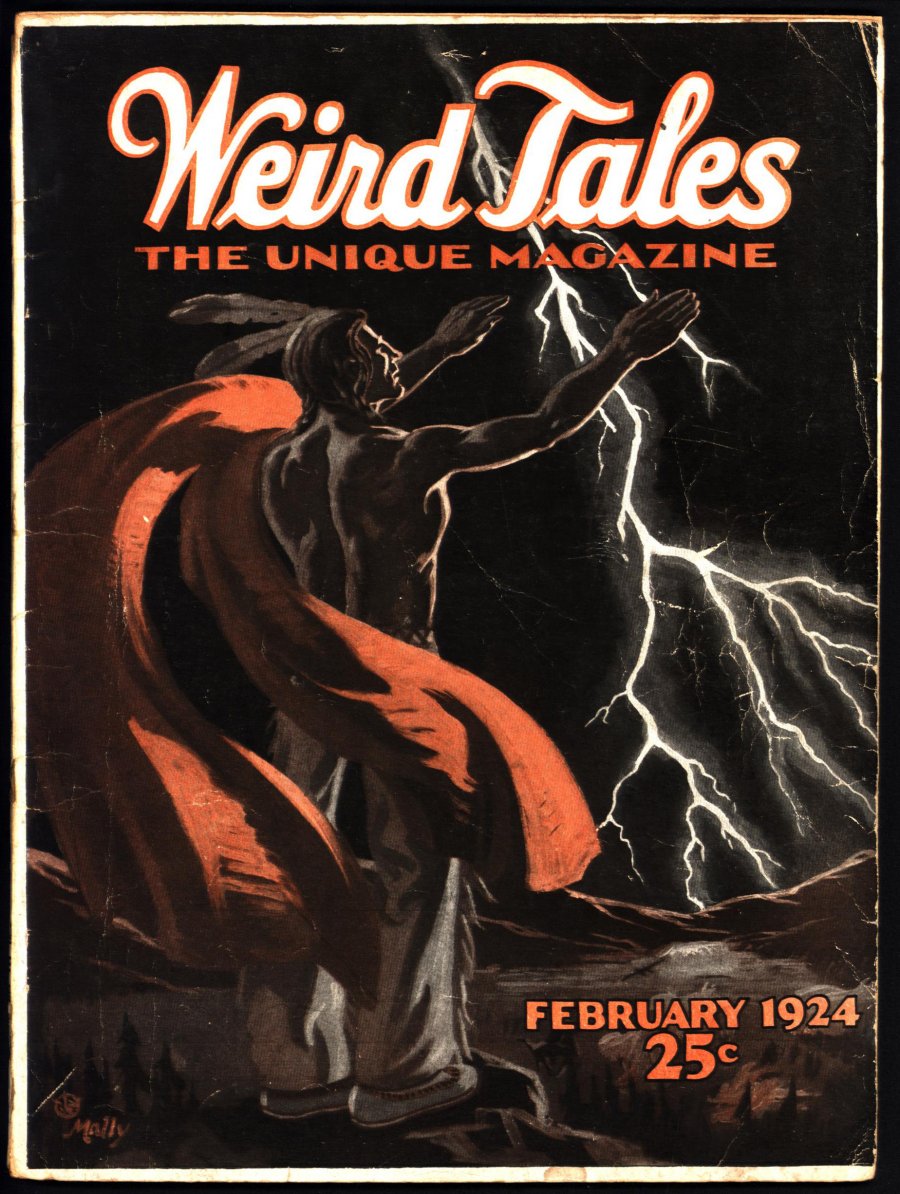
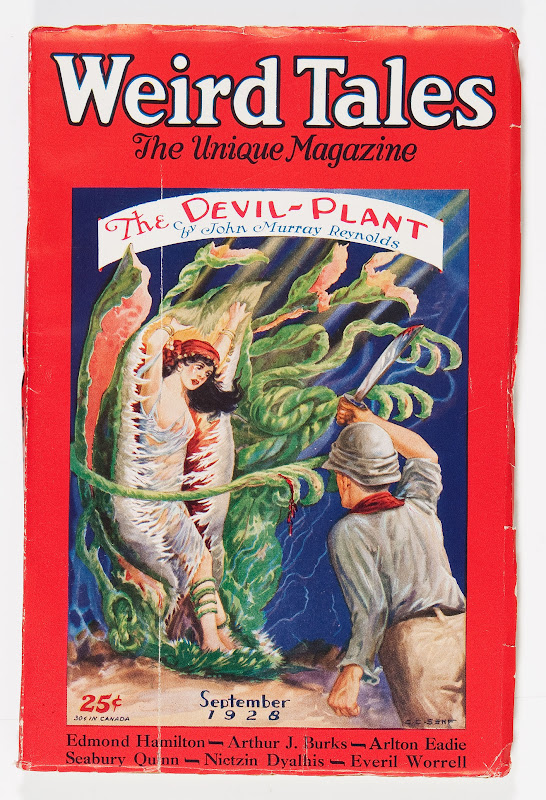
March 1923 · The first issueThe magazine’s first number carried Wright’s own story, “The Closing Hand.” Tap the picture to see it larger.February 1924The year Wright took the chair — editor from the November 1924 issue. Tap the picture to see it larger.Sept. 1928 · C. C. SenfThe Wright era at its height, in this volume’s years. Tap the picture to see it larger.
A Wright-era issue — Weird Tales, September 1928, with a cover by C. C. Senf, one of the two artists Wright settled the magazine’s covers on in 1927. There is no single biography of Wright to set beside the Bacon and Shaw volumes; his monument is the run of the magazine itself.
Farnsworth Wright
Editor of Weird Tales · “The Unique Magazine”
1888–1940 · Editor, November 1924 – March 1940
Farnsworth Wright was born on July 29, 1888, in Santa Barbara, California. His mother was a soprano and music teacher, and the classics and poetry stayed with him for life — he made Weird Tales one of the very few pulp magazines that regularly printed verse. He studied journalism at the University of Nevada and the University of Washington, where he rose to managing editor of the campus daily, worked as a reporter, served in the infantry in the First World War — acting as a French interpreter — and was working as a music critic for the Chicago Herald and Examiner when Weird Tales began. He was a writer before he was its editor: his story “The Closing Hand” appeared in the magazine’s very first issue, in March 1923. As its editor he would later slip his own poems and a story into its pages under the pen name Francis Hard.
The magazine nearly died in its first year. Founder J. C. Henneberger fired the founding editor, Edwin Baird, shut the magazine down while he rescued its finances, and relaunched it in November 1924 with Wright — who had been reading its manuscripts — in the editor’s chair. Wright ran it for sixteen years on a shoestring: pay was low and sometimes slow, the budget for everything was thin, and the magazine more than once came close to folding. What it had instead was his taste. He was picky, he kept the magazine’s mixture unlike anything else on the newsstand — horror, fantasy, science fiction, occult tales, and poetry in a single issue — and through “The Eyrie,” the magazine’s letter column, he let its readers argue about the stories in print and vote on their favorites, building the first real community in the field.
That taste could frustrate even his stars — Wright rejected work from Lovecraft, Howard, and Smith as well as buying it, and the Three Musketeers’ letters are full of complaints about his decisions and his rates alongside their gratitude. Howard put the other side of it plainly in 1931: Wright, he wrote, had given him his start by buying his first story. On the art side, Wright made the same kind of settling decision Shaw made at Black Mask: in 1927 he put the covers largely into the hands of two men, C. C. Senf — 45 covers from March 1927 — and Hugh Rankin, hired that year, who drew interiors from the July 1927 issue and painted 15 covers, sometimes signing them “DOAK.” Between them, Senf and Rankin painted all but one of the magazine’s covers for the rest of this volume’s years. The full shelf of his magazine is on the Weird Tales and Horror page.
From 1930 Wright also edited a companion magazine, Oriental Stories, later renamed The Magic Carpet Magazine, which ran until 1934. All the while his health was failing: Parkinson’s disease had declared itself in the early 1920s, and by about 1930 the shaking was so bad he could no longer sign his own name. Ill health forced him to resign in March 1940; Dorothy McIlwraith succeeded him, and he died in New York on June 12, 1940, aged fifty-one. Seabury Quinn’s tribute ran in “The Eyrie” that November — the column Wright himself had made the magazine’s beating heart.
Weird Tales · Edited November 1924 – March 1940 · 179 issues · Succeeded founding editor Edwin Baird (1923–1924) · Succeeded by Dorothy McIlwraith (1940) · Also editor of Oriental Stories / The Magic Carpet Magazine (1930–1934)
The book to read — a history of the magazine, not a biography of the man
There is no single biography of Farnsworth Wright to set beside Milton Shaw’s life of his father and Laurie Powers’ life of Daisy Bacon — the statement stands, and Wright’s monument remains the run of Weird Tales itself. The book that belongs on his shelf instead is a history of that magazine: Robert Weinberg’s The Weird Tales Story, first published in 1977 and still in print in the expanded edition below.
The magazine the book is about — Weird Tales, March 1923, the first issue, which carried Wright’s own story “The Closing Hand.” The book’s own cover is not reproduced here.
The Weird Tales Story
Expanded and Enhanced — a history of Weird Tales magazine
By Robert Weinberg · Pulp Hero Press · 2021
Robert Weinberg (1946–2016) — pulp historian, collector, and himself a Weird Tales contributor — published The Weird Tales Story with FAX Collector’s Editions in 1977, the first book-length history of “The Unique Magazine”; Wildside Press reprinted it in 1999. The edition linked here is the one to buy now: Pulp Hero Press’s Expanded and Enhanced edition of 2021, which keeps Weinberg’s original narrative and enlarges it with contributions from a who’s who of pulp scholars — S. T. Joshi, Darrell Schweitzer, Mike Ashley, Rob Roehm, Bobby Derie, Jason Ray Carney, Adrian Cole, Morgan Holmes, and Terence E. Hanley.
It is a history of the magazine, not a life of its editor, and it is catalogued that way here on purpose. But no one can tell the magazine’s story without Wright: his sixteen years in the chair, the Three Musketeers he gathered, the rates his writers grumbled about, and the letter column that built the field’s first community are the spine of Weinberg’s book, just as they are the spine of this page. Readers who want Wright in depth will find more of him here than anywhere else between two covers.
Pulp Hero Press · 2021 · Paperback · 342 pages · ISBN 978-1-68390-222-5 · $29.95 · First published FAX Collector’s Editions, 1977; Wildside Press reprint, 1999
Weird Tales was not Wright’s only chair. Its companion title is filed here, on his page, rather than given a category of its own.
Oriental Stories — later The Magic Carpet Magazine
Weird Tales publisher · 1930–1934 · Adventure of the East · Edited by Wright
From 1930, alongside Weird Tales, Wright also edited a companion magazine, Oriental Stories — adventure and fantastic tales of the East, from the same publisher and the same editor’s desk. Renamed The Magic Carpet Magazine, it ran until 1934. Only its first year, 1930, falls inside this volume; the title belongs to Wright’s story rather than to any one shelf of magazines, and it is recorded here for that reason.
Filed withFarnsworth Wright — see his biography above
The Three Musketeers of Weird Tales
Lovecraft, Smith, and Howard never met as a trio — they knew each other through letters and through Wright’s pages — but readers grouped them early, and the name stuck: the Three Musketeers, the three writers who set the standard for quality and originality in the magazine. Each brought Wright something no other pulp editor in America was printing.
H. P. Lovecraft
1890–1937 · Providence, Rhode Island · Cosmic horror
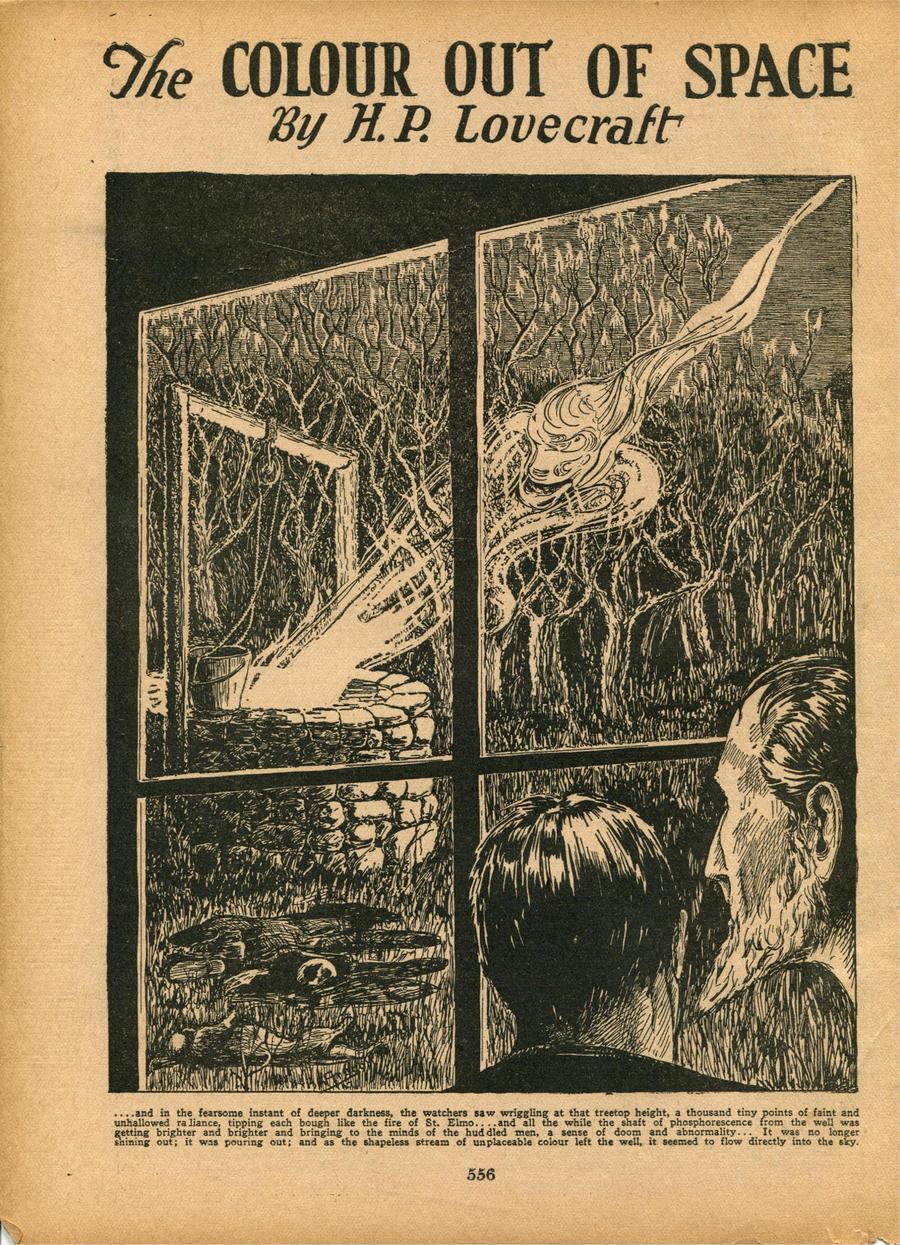
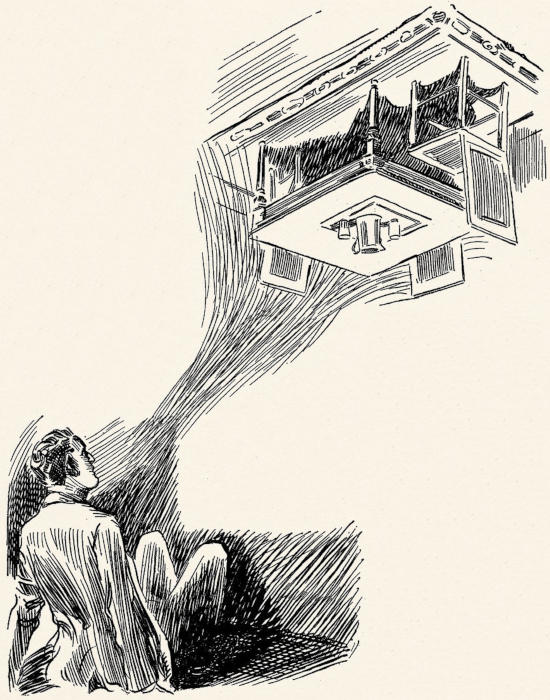
Lovecraft in print, 1927“The Colour Out of Space,” illustrated by de Aragon. Tap the picture to see it larger.
The ringleader of the three, and the center of the circle of correspondents — Howard and Smith among them — who traded ideas, manuscripts, and invented gods by mail. Wright published the heart of his work: “The Call of Cthulhu” (February 1928), “The Dunwich Horror” (1929), and story after story of the Cthulhu Mythos, building in public the mythology that made Lovecraft, after his death, the most influential horror writer of the century.
Wright bought much of it, argued over some of it, and rejected some of it — the friction is part of the record. What no other editor offered Lovecraft was a regular home, an audience that wrote back, and a letter column where his readers became his disciples.
Clark Ashton Smith
1893–1961 · Auburn, California · Poet of the fantastic
Inside the magazineAn interior from Weird Tales’ first year. Tap the picture to see it larger.
A poet and sculptor before he was a pulp writer, Smith had corresponded with Lovecraft since 1922, and Wright — one of the few pulp editors who valued poetry — printed his verse as well as his prose. When Smith turned seriously to fiction at the end of the 1920s, beginning in Weird Tales with “The Ninth Skeleton” in 1928, Wright bought story after story: the jeweled, baroque tales of Hyperborea, Poseidonis, and Zothique that no slick magazine would have touched.
Of the three, Smith was the stylist — prose like carved and colored stone — and Wright’s willingness to print it, month after month, is the clearest measure of the magazine he was making.
Robert E. Howard
1906–1936 · Cross Plains, Texas · Sword and sorcery
The magazine Howard foundWeird Tales, February 1924. Tap the picture to see it larger.
The youngest Musketeer, and the last to arrive. Howard sold Wright his first story, “Spear and Fang,” at eighteen — it appeared in July 1925 — and wrote to the editor in 1931: “You gave me my start in the racket by buying my first story.” Wright was, as Howard’s historians put it, the man most directly responsible for his income.
In Wright’s pages Howard invented sword and sorcery: Solomon Kane, then “The Shadow Kingdom” (1929), the first Kull story, and Bran Mak Morn — with Conan the Cimmerian still to come in 1932, just past this volume’s close. He counted Hugh Rankin, Wright’s cover artist, his favorite illustrator of his stories.
Historically Significant Pulp Editors
This site groups its three editors together. Three editors, three magazines, three whole kinds of American popular fiction — each one defined, in its classic years, by the taste of a single person in the editor’s chair.
Joseph T. Shaw
Black Mask · 1926–1936
The hard-boiled school
“Cap” Shaw built Black Mask around Hammett, Chandler, and Daly — and resigned rather than cut his writers’ pay. Read his page →
Farnsworth Wright
Weird Tales · 1924–1940
Weird fiction
Sixteen years and 179 issues of “The Unique Magazine,” built around Lovecraft, Smith, and Howard — the page you are reading.
Daisy Bacon
Love Story Magazine · 1928–1947
Romance
Editor of the best-selling pulp of all time, and the most powerful woman editor in the field. Read her page →
Wright’s influence outran his magazine. The writers he gathered — the Musketeers first, and after them August Derleth, Frank Belknap Long, C. L. Moore, Robert Bloch, and dozens more — carried weird fiction out of the pulps and into the modern horror and fantasy fields, and Derleth founded Arkham House in 1939 largely to keep Lovecraft’s work, first printed by Wright, in print. Every modern editor of a horror or fantasy magazine works in a house Wright built.